Key Takeaways
See the full list of key takeaways at the top of this article before reading.
Most people treat a birth chart compatibility calculator like a vending machine — put in two names and two birthdays, get out a relationship verdict. But here's the thing: the output is only as trustworthy as what you feed it. And the single most corrupting variable in any synastry calculation isn't the software, the orb settings, or even which house system you use. It's birth time.
This article isn't about which calculator is prettier or has more features. It's about understanding why your results might be quietly wrong — and what you can do about it before drawing any conclusions about compatibility.
What a Birth Chart Compatibility Calculator Actually Computes
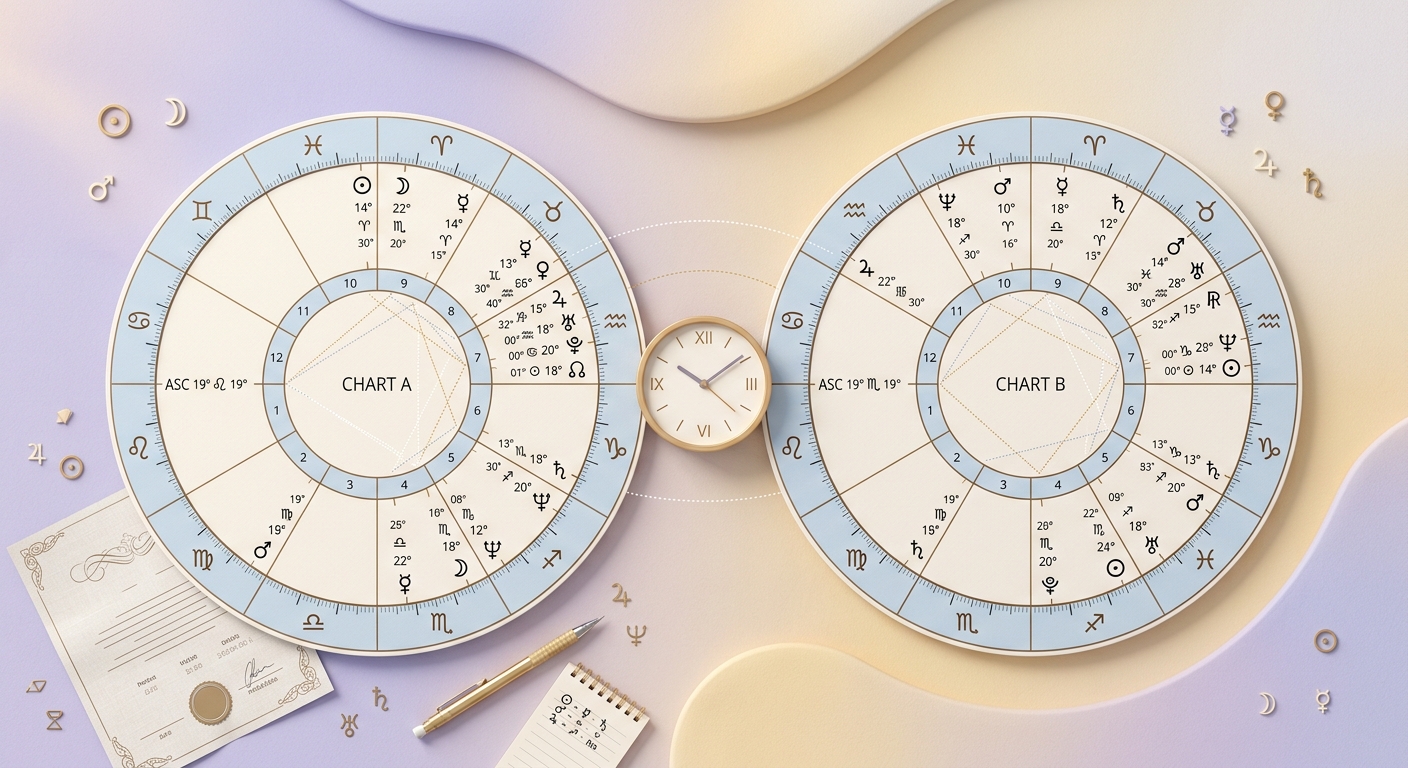
A birth chart compatibility calculator — sometimes called a synastry calculator — takes two sets of birth data and maps how one person's planetary positions interact with the other's. Every planet in your chart occupies a specific degree of a specific zodiac sign at the moment of your birth. When those positions are overlaid with another person's chart, the angles between planets (called aspects) and the houses those planets fall into create a picture of relational dynamics.
That picture includes things like how you communicate emotionally, where you create friction, which areas of life you activate in each other, and where long-term tension might live. (A professional synastry chart reading goes several layers deeper than most calculators will show you, but even at the basic level, the math needs to be right.)
The problem is that several of the most sensitive outputs — Ascendant sign, house placements, and even Moon sign in borderline cases — depend entirely on knowing the exact time of birth. Not the approximate time. Not "sometime in the afternoon." The exact time.
Why Birth Time Is the Make-or-Break Factor in Synastry
The Earth rotates roughly one degree every four minutes. That means your Ascendant — the zodiac sign rising on the eastern horizon at the moment of your birth — shifts by one degree every four minutes, and changes sign entirely roughly every two hours. Your house cusps rotate with it.
In synastry, this matters enormously. Two people born in the same city on the same day but two hours apart can have completely different house overlays, different Ascendant-based aspects, and in some cases, even a different Moon sign.
Ascendant and House Cusps: Minutes Matter
The Ascendant is arguably the most time-sensitive point in any birth chart. A 15-minute error in birth time can shift the Ascendant by 3-4 degrees. In a tight synastry reading, that's the difference between your partner's Venus forming a conjunction with your Ascendant (one of the most classically romantic overlays in astrology) versus falling in your 12th house instead of your 1st — a completely different interpretive territory.
House cusps are equally vulnerable. The difference between someone's Sun landing in your 7th house (the house of partnership) versus your 6th house (the house of work and service) is not a minor interpretive tweak. It's a fundamentally different story about what role this person plays in your life.
For a deeper look at why house placements in synastry carry so much weight, Synastry House Overlays: Which Houses Actually Matter for Romantic Compatibility breaks this down in useful detail.
Moon Sign Shifts: The 2.5-Day Window Problem
The Moon moves through a full zodiac sign approximately every 2.5 days, which translates to roughly one degree every two hours. For most people born mid-sign, a birth time error of an hour or two won't change the Moon sign. But if you were born near the end or beginning of a lunar transit — say, when the Moon was at 28° Scorpio or 1° Sagittarius — even a small time error can flip your Moon sign entirely.
Why does this matter for compatibility? Because Moon sign compatibility is one of the most emotionally significant factors in synastry. A Moon-Moon trine between two people suggests emotional attunement and instinctive understanding. A Moon-Moon square can indicate recurring emotional friction. Getting the Moon sign wrong means you could be reading an entirely fictional emotional dynamic.
If you want to understand what's actually at stake when Moon signs interact in synastry, Moon Sign Compatibility in Synastry: The Emotional Layer Most People Skip is worth reading alongside this.
What Happens When You Enter an Approximate Birth Time
Let's say you don't know your exact birth time, but you remember your mother saying it was "around 3 in the afternoon." You enter 3:00 PM into the calculator. This is a very common scenario — and it introduces compounding errors that most people don't realize are happening.
House Overlay Errors
With an approximate time, every house cusp in your chart is estimated, not calculated. Depending on your latitude, a 30-minute error can shift house cusps by 7-8 degrees. That's enough to move a planet from one house to another — or to change whether two people share a significant house overlay at all.
Imagine your partner's Saturn falls at 14° Capricorn. With an accurate birth time, that Saturn lands in your 10th house — a demanding but potentially stabilizing influence on your career and public life together. With a 30-minute time error, it might land in your 9th house instead, suggesting a different kind of influence entirely. The aspect between Saturn and your natal planets doesn't change, but the house story — which is half of what synastry is actually reading — does.
Aspect Orb Distortions
Aspects between planets (trines, squares, conjunctions, oppositions) are calculated by degree, and most planets move slowly enough that a birth time error of an hour or two won't change them significantly. The Sun moves roughly one degree per day. Jupiter moves about one degree every 12 days. So a 2-hour error in birth time has almost no effect on Sun-Jupiter aspects.
But fast-moving points are different. The Moon moves 12-15 degrees per day. The Ascendant and Midheaven move through the entire zodiac in 24 hours. So aspects involving the Moon, Ascendant, or Midheaven — some of the most personally significant points in synastry — are highly sensitive to birth time errors.
A Moon conjunct Ascendant aspect (often described as an instant sense of recognition between two people) can disappear entirely with a 45-minute time error. You'd be reading a connection that the calculator has simply invented.
No Birth Time? What You Can Still Learn From a Noon Chart
Here's the practical reality: a significant number of people genuinely don't know their birth time. Hospital records weren't always kept. Birth certificates in some countries don't include time. Memory is unreliable.
When birth time is unknown, most reputable calculators default to a noon chart — a chart cast for 12:00 PM on the birth date. This isn't a guess at the actual birth time. It's a methodological choice that minimizes the Moon sign error (since noon places the Moon at the midpoint of the day's lunar travel, the sign is more likely to be correct than if you guessed midnight or 6 AM).
What a noon chart can reliably tell you:
- Sun sign, Mercury sign, Venus sign, Mars sign, Jupiter sign, Saturn sign, and outer planet signs (all accurate regardless of birth time in most cases)
- The general quality of planetary aspects between slow-moving planets
- Sun-Moon interaspects, provided neither person's Moon is near a sign boundary
What a noon chart cannot reliably tell you:
- Ascendant or Descendant
- Any house placements
- Accurate Moon sign if the Moon was changing signs that day
- Midheaven or IC
So a noon chart gives you a partial synastry reading — useful for understanding the planetary conversation, but silent on the house overlay story, which is often where the most personally specific insights live.
How to Verify Your Birth Time for Better Synastry Results
Before accepting approximate results, it's worth trying to pin down your actual birth time. There are three main routes.
Birth Certificate vs. Hospital Records vs. Rectification
Birth certificate: In many countries (the US, UK, most of Europe), birth certificates include the time of birth. If you've only ever seen a short-form certificate, request the long-form version — it often contains the time when the short form doesn't. This is your first and most reliable option.
Hospital records: If your birth certificate doesn't include a time, the hospital where you were born may have records. Delivery room logs, nursing notes, and admission records sometimes capture birth time with more precision than official documents. This requires a formal records request and can take weeks, but it's worth it if you're serious about accurate synastry.
Birth time rectification: When no records exist, astrologers use a technique called birth time rectification — working backwards from known life events (marriages, career shifts, major losses) to identify which birth time would have produced the transits and progressions consistent with those events. It's a skilled process that takes time, but it can narrow an unknown birth time to within 15-30 minutes in many cases. This is not something a calculator can do for you; it requires a human astrologer.
Calculator Comparison: How Cafe Astrology and AstroSeek Handle Unknown Times
Not all calculators handle missing birth time data the same way, and the difference matters.
Cafe Astrology prompts users to enter a birth time and accepts "unknown" as an input. When time is unknown, it defaults to a noon chart and clearly labels the Ascendant and house cusps as unavailable or approximate. The interface is relatively transparent about what it can and can't calculate — which is genuinely useful for people who know their data is incomplete.
AstroSeek offers a more granular approach. It allows users to specify time accuracy (exact, approximate, or unknown) and adjusts its output labeling accordingly. It also includes a built-in rectification tool for users who want to estimate birth time based on life events — a feature Cafe Astrology doesn't offer directly.
Both platforms produce accurate planetary positions for known birth data. The meaningful difference is in how they handle uncertainty and what they show you when your data is imperfect. For a full breakdown of what each platform includes and where each falls short, the synastry chart comparison between Cafe Astrology and AstroSeek covers the functional differences in detail.
The broader point is that the calculator itself is rarely the weak link. If your results feel off, or if two readings from different tools give you dramatically different house overlays, the first question to ask isn't "which tool is more accurate?" — it's "how precise is the birth time I entered?"
| Data Quality | What You Can Trust | What You Can't Trust |
|---|---|---|
| Exact birth time (verified) | All placements, aspects, house overlays | Nothing — this is full synastry |
| Approximate time (±30 min) | Slow-planet aspects, most Moon signs | House cusps, Ascendant, fast-point aspects |
| Unknown (noon chart) | Sun/Mercury/Venus/Mars signs, slow aspects | All house data, Ascendant, borderline Moon |
Getting the Most From Your Compatibility Calculator Results
The goal isn't to dismiss what a birth chart compatibility calculator can do — it's to use it with clear eyes about what the output actually means given the data you've entered.
If you have verified birth times for both people, a good synastry calculator gives you genuinely rich material to work with. The house overlays alone can tell you a great deal about the functional role each person plays in the other's life. Aspects between personal planets — Sun, Moon, Venus, Mars — describe the emotional and relational texture. And slower-moving contacts involving Saturn or the outer planets often describe the relationship's longer arc. (For what Saturn specifically brings to synastry, Saturn Aspects in Synastry: Why the 'Difficult' Planet Is the One You Actually Want reframes that planet's role in ways that might surprise you.)
If your birth time is approximate or unknown, treat the output as a partial reading. Use it to understand the planetary layer — signs, slow-planet aspects, Sun-Moon dynamics — and hold the house overlay interpretation loosely until you can verify the time.
And if you're finding the raw chart output hard to interpret, How to Actually Read a Synastry Chart: What to Look at First, Second, and Last offers a structured approach to prioritizing what matters.
The most useful thing any compatibility calculator can do is give you accurate raw data. What you do with that data — how you interpret it, what weight you give each factor, how you hold it in context with the actual lived experience of a relationship — is where the real work happens. A calculator can point you toward the questions. It can't answer them for you.
Start with your birth certificate. Verify the time. Then run the chart. In that order.