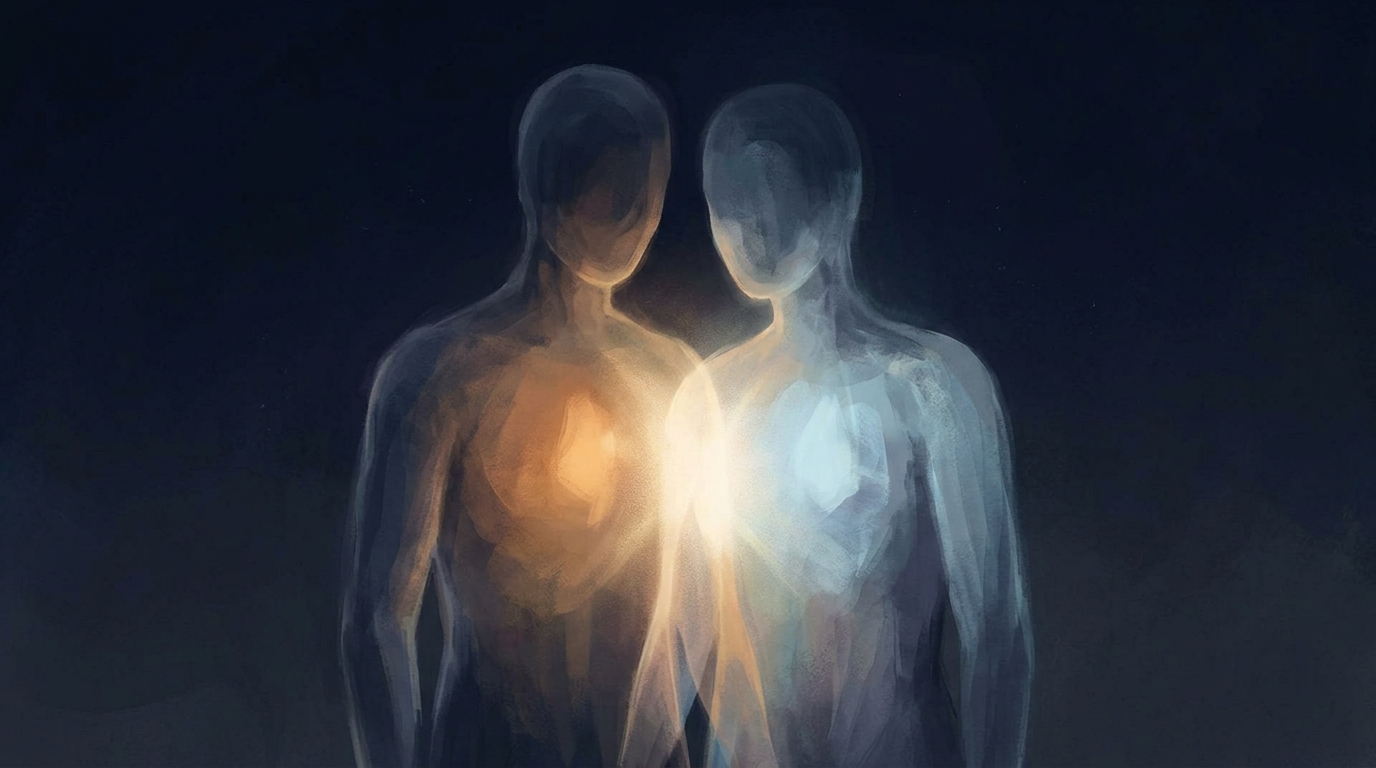
There's a particular kind of relationship that gets under your skin in a way you can't explain. The chemistry is real, the connection feels significant, and yet something keeps surfacing — an old ache, a familiar insecurity, a pattern you thought you'd dealt with years ago. If you've looked at the synastry chart for that relationship and found Chiron making contact with your partner's personal planets, you've probably read something like "Chiron brings healing" or "Chiron wounds the other person." Both of those framings miss the point.
Chiron doesn't wound anyone. It finds the wound that was already there and holds it up to the light.
What Chiron Is and Why It Shows Up in Relationship Charts
Chiron is a minor planet — technically a centaur object — orbiting between Saturn and Uranus. In mythology, Chiron was the wounded healer: a centaur who suffered an unhealable wound yet became the greatest teacher of heroes. That paradox is exactly what Chiron represents in a natal chart. It marks the place where a person carries a core wound, usually formed in childhood or early experience, and where that wound, when worked with consciously, becomes a source of unusual depth and even wisdom.
In a natal chart, Chiron's house and sign placement describe the nature and arena of that wound. But in synastry — when two charts are overlaid — Chiron becomes something more active. It describes where two people's wounds intersect, where one person's raw place meets another's energy, and what that contact produces.
The reason Chiron shows up so prominently in relationship charts is straightforward: intimate relationships are where our deepest material gets activated. A Chiron contact in synastry doesn't manufacture pain. It reveals healing and wounding dynamics that already existed in both people, brought to the surface by proximity and emotional investment. Understanding how Chiron aspects interact with the major aspect types gives you a structural foundation for reading what follows.
Chiron Conjunct Personal Planets: Where the Wound Gets Activated
Conjunctions are the most direct contacts in any synastry chart. When Chiron conjoins a personal planet — Sun, Moon, Mercury, Venus, Mars — the effect is immediate and often visceral. The Chiron person doesn't mean to press on anything. They just do, by being who they are.
Chiron Conjunct Sun: Identity and Visibility
When one person's Chiron sits on another's Sun, questions of identity and visibility come into focus fast. The Sun person may feel simultaneously seen and exposed — as if the Chiron person can perceive something about them that they've worked hard to keep private, usually something related to self-worth or the right to take up space.
This doesn't mean the Chiron person is doing anything deliberately. Often they're not even aware of it. What's happening is that the Chiron person's presence activates the Sun person's wound around identity — the old story of "I'm not enough" or "I have to earn my place." In a healthy dynamic with enough self-awareness on both sides, this contact can push the Sun person toward a more authentic expression of self. In a dynamic without that awareness, it can feel like the Chiron person is constantly undermining them, even when they're not.
Chiron Conjunct Venus: Love and Worthiness
Chiron conjunct Venus synastry is probably the most written-about Chiron contact, and for good reason. Venus governs how we give and receive love, what we believe we deserve, and how we value ourselves in relationship. When Chiron lands on someone's Venus, the wound around love and worthiness gets activated directly.
The Venus person may find themselves cycling through a familiar loop: feeling deeply loved by the Chiron person, then suddenly convinced they don't deserve it, then pulling back or testing the relationship. The Chiron person, for their part, may feel responsible for the Venus person's pain without understanding why — or may find that the relationship triggers their own wound around love and belonging.
What this contact often reveals is that the Venus person's wound around worthiness predates the relationship entirely. The Chiron person is a mirror, not a cause. That's a critical distinction, and one that most generic Chiron synastry interpretations skip entirely.
Chiron Conjunct Moon: Emotional Safety
The Moon rules emotional security, early conditioning, and the felt sense of home. Chiron conjunct Moon in synastry tends to activate wounds around emotional safety — specifically, the wound of not having had one's emotional needs met early in life.
This contact creates a dynamic where the Moon person feels both deeply understood and deeply vulnerable with the Chiron person. The Chiron person seems to intuitively grasp the Moon person's emotional world, which can feel like a relief — and then, precisely because the connection feels so safe, old material starts surfacing. Grief, abandonment fears, the sense that emotional needs are too much or too demanding. None of this is the Chiron person's fault. But it does mean the relationship will require both people to have some capacity for sitting with discomfort rather than running from it.
For a deeper look at how emotional compatibility layers into synastry, Moon sign compatibility is worth reading alongside any Chiron analysis.
Chiron Square or Opposite Personal Planets: Friction That Demands Growth
Conjunctions activate. Squares and oppositions create friction — and with Chiron, that friction tends to be harder to ignore.
A Chiron square to someone's Venus, for example, doesn't feel like gentle illumination. It feels like something is consistently off: the Chiron person says something innocuous and the Venus person feels criticized; the Venus person reaches for connection and the Chiron person withdraws. The pattern repeats, and neither person quite understands why.
Oppositions work differently — there's more awareness of the dynamic, but it often manifests as projection. The Chiron person sees their wound reflected in the other person's behavior. The other person feels blamed for something they didn't do. Both are, in some sense, right.
Hard Chiron aspects in synastry are not relationship death sentences. But they do require more conscious work than soft aspects. The relationship will keep returning to the same pressure point until both people are willing to look at what's actually being triggered — and to take responsibility for their own wound rather than assigning it to the other person.
This is where the comparison to Saturn aspects in synastry is instructive. Saturn contacts also create friction and demand maturity. The difference is that Saturn tests commitment and structure, while Chiron tests emotional honesty and self-awareness. Both can build something lasting. Neither is easy.
When Chiron Contacts Signal a Healing Relationship vs. a Harmful One
This is the question most people are actually asking when they look up Chiron in synastry: is this relationship good for me or is it hurting me?
The honest answer is that the Chiron contact itself doesn't determine that. What matters is what both people do with the activation.
A few markers of a Chiron contact that's moving toward healing:
- Both people can name what gets triggered without immediately blaming the other person for triggering it
- The relationship creates space for vulnerability without punishment
- Old patterns surface, but there's enough safety to actually examine them rather than just reenact them
- The pain has a quality of "this is mine to work with" rather than "this person is doing this to me"
Markers that a Chiron contact is becoming harmful:
- One or both people consistently use the other's wound as a weapon, even unconsciously
- The activation never leads to insight — just repeated cycles of pain and withdrawal
- One person carries all the "wounded" energy while the other plays the role of healer (this dynamic tends to collapse)
- The relationship reinforces the wound rather than illuminating it
A Chiron-heavy synastry is not a red flag. It's a signal that this relationship operates at a deeper emotional register than most — and that it will ask more of both people in terms of self-knowledge. Whether that's a gift or a burden depends almost entirely on what each person brings to it.
It's also worth noting that Chiron contacts don't exist in isolation. They interact with everything else in the chart. A Chiron conjunct Venus with a strong Saturn trine might produce a relationship where the wound is held with enough structure to actually heal. A Chiron conjunct Moon with a Mars square might mean the emotional activation gets expressed as conflict before it can be processed. Reading Chiron in the context of the full synastry picture matters — see how to actually read a synastry chart for a framework on where to start.
Reading Chiron in Context — Not in Isolation
One of the persistent problems with Chiron synastry interpretation is that people encounter a single aspect — say, Chiron conjunct Venus — and treat it as the defining feature of the relationship. It rarely is.
Chiron contacts tell you where the emotional depth lives in a relationship. They don't tell you whether the relationship will work, whether there's compatibility, or whether the two people have the emotional resources to handle what gets activated. For that, you need the rest of the chart.
House overlays matter here too. Where does the Chiron person's Chiron fall in the other person's chart? A Chiron landing in someone's 7th house activates wounds around partnership and relating directly. In the 4th house, it touches family and foundational security. In the 10th, it may surface wounds around public identity and achievement. The synastry house overlays framework adds a layer of specificity that aspect-only readings miss.
There's also the question of what each person's natal Chiron looks like. Someone with Chiron prominently placed in their natal chart — conjunct an angle, say, or heavily aspected — will experience Chiron synastry contacts differently than someone whose natal Chiron is relatively unaspected. The more conscious someone is of their own Chiron wound, the more they can work with it rather than simply react from it.
Some relationships with strong Chiron contacts feel fated — not in a romantic, destined sense, but in the sense that they seem to arrive exactly when a person's unresolved material is ready to surface. If that resonates, the North Node in synastry is worth examining alongside Chiron, since both speak to the sense of purposeful connection.
The pattern that keeps showing up in your relationships isn't coming from the relationships themselves. It's coming from you — and from the wound that hasn't yet been fully seen. The right relationship, with the right Chiron contact, doesn't create that wound. It just finally makes it visible enough to work with.
If you want to understand what Chiron is actually doing in your specific relationship chart, talk to a specialist about Chiron in your relationship chart who can read the full picture rather than a single aspect in isolation.