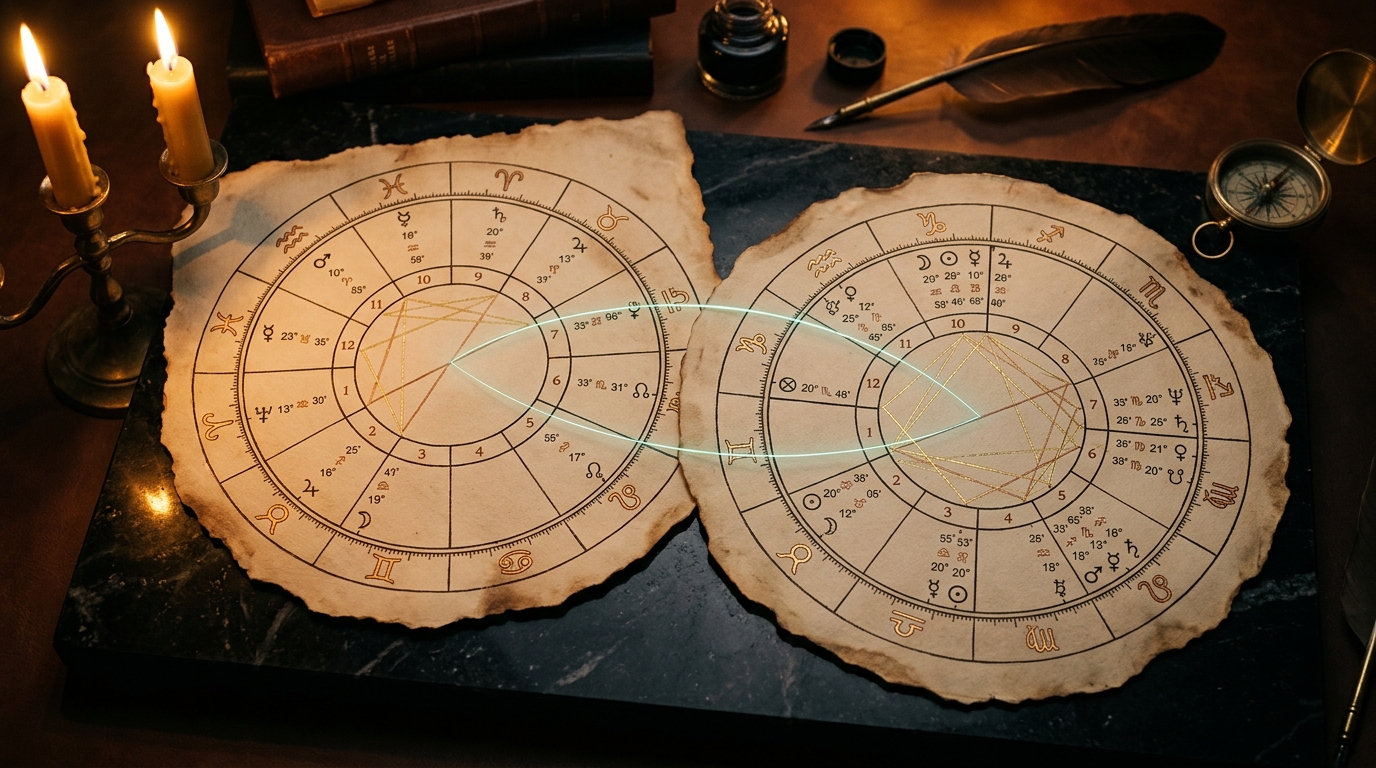
Most people stumble onto the composite chart first. It shows up in every astrology app, gets discussed in every relationship reading, and has become the default answer when someone asks "what chart do I use for a couple?" The Davison chart, meanwhile, sits in the background — technically available in most serious software, rarely explained, and almost never the first thing a beginner encounters.
That's a problem, because these two charts answer different questions. Using the wrong one isn't just inefficient — it's like asking a thermometer to measure distance. Both tools involve astrology, both tools involve two people, but they're built on fundamentally different logic and they're best suited to fundamentally different inquiries.
Here's the argument this article makes: the composite chart is better for understanding what a relationship is, while the Davison chart is better for understanding what a relationship does over time. Once you grasp that distinction — and understand the calculation difference behind it — you'll know exactly which one to reach for.
Why There Are Two 'Relationship Charts' and Which One You've Probably Seen
Relationship astrology has always had a tension at its core. You have two people, each with their own birth chart. How do you represent the relationship itself — not the individuals, not the comparison between them, but the third entity that forms when two people come together?
Synastry (overlaying two charts) shows how Person A's planets interact with Person B's planets. It's inherently about the push and pull between two separate beings. But astrologers wanted something more: a single chart that belonged to the relationship, not to either person.
Two different solutions emerged, decades apart. The composite chart came first in widespread use, popularized through Robert Hand's influential work in the 1970s. The Davison chart — named for British astrologer Ronald Davison, who introduced it in his 1983 book Synastry — arrived as an alternative with a distinctly different mathematical foundation.
Most beginners encounter the composite first because it's the one astrology apps default to. Type in two birthdates, hit "relationship chart," and you almost certainly get a composite. The Davison requires either knowing to ask for it specifically, or using software that offers both options.
How the Composite Chart Is Calculated (and What It Represents)
The composite chart is a midpoint chart. Take every planet in Person A's natal chart and find the midpoint between it and the corresponding planet in Person B's chart. The midpoint between two Suns, the midpoint between two Moons, the midpoint between two Mercurys — do this for every planet and point, and you have the composite chart.
The Ascendant and Midheaven are calculated the same way: midpoints of the two individuals' Ascendants and Midheavens.
What this produces is a chart that doesn't correspond to any actual moment in time or any actual place on Earth. It's a mathematical abstraction — a geometric average of two people's planetary positions. There's no date you could point to and say "this is when this chart was cast." The composite Sun at 15° Scorpio doesn't mean anything happened at 15° Scorpio on a specific day. It's a derived position.
This abstract quality is actually part of what makes the composite chart useful for character questions. It describes the relationship's essential nature: the composite Sun sign speaks to the relationship's core identity and purpose, the composite Moon to its emotional tone, composite Venus to how the couple expresses affection and what they value together. These are stable, ongoing qualities — not tied to a moment in time.
For understanding synastry house overlays and how planets fall in each other's houses, the composite chart gives you a clean single chart to work with rather than two overlapping ones.
How the Davison Chart Is Calculated (and Why It's Different
The Davison chart takes a completely different approach. Instead of calculating midpoints between planetary positions, it calculates the midpoint in time between two people's births, and the midpoint in space between their birthplaces.
Say Person A was born on March 10, 1985, in New York, and Person B was born on September 20, 1990, in London. The Davison chart is cast for the exact midpoint date and time between those two births — roughly June 1988, splitting the difference — and for the geographic midpoint between New York and London, which falls somewhere in the mid-Atlantic.
This produces a chart for an actual moment in time and an actual (if arbitrary) location on Earth. You can run transits and progressions to a Davison chart in the same way you'd run them to a natal chart. That's not true of a composite chart, where the abstract midpoints don't respond to transits in the same predictable way.
The Davison chart differs from the composite chart in calculation method in a way that has real interpretive consequences: because the Davison is anchored to a real date and place, it has a living relationship with time. Transiting Saturn crossing the Davison chart's 7th house cusp will behave like transiting Saturn crossing a natal 7th house cusp — with weight, with pressure, with the sense that something real is being tested.
This is why practitioners who work with relationship timing — asking "when will this relationship face its biggest challenge?" or "what years will be most significant for this couple?" — tend to prefer the Davison. It responds to predictive techniques more reliably than the composite does.
Composite vs. Davison: A Side-by-Side Comparison
| Feature | Composite Chart | Davison Chart |
|---|---|---|
| Calculation basis | Midpoints of planetary positions | Midpoint in time and space |
| Corresponds to real date/place? | No | Yes |
| Works with transits/progressions? | Limited, debated | Yes, reliably |
| Best for | Relationship character, ongoing themes | Timing, predictive work |
| Ascendant/MC calculation | Midpoint of both people's angles | Derived from actual midpoint date/location |
| Availability in apps | Near-universal | Less common, requires specific software |
The charts will often look similar — they're drawing from the same two people, after all — but they can differ significantly in house placements and even in which signs certain planets fall in, depending on how far apart the two birth times and locations are.
What Each Chart Is Best Used For
The composite chart excels at answering questions about the relationship's fundamental nature:
- What is the emotional core of this relationship? (Composite Moon sign and house)
- How do these two people communicate as a unit? (Composite Mercury)
- What challenges are built into the fabric of this connection? (Composite Saturn aspects)
- What is the relationship's public face vs. its private reality? (Composite Ascendant vs. composite 4th house)
For those interested in how Saturn aspects shape long-term compatibility, the composite chart is often the cleaner place to examine that — Saturn's position in the composite speaks to the structural demands built into the relationship itself.
The Davison chart excels at timing and developmental questions:
- When is this relationship likely to face a major turning point?
- What periods will feel expansive vs. contracting for the couple?
- How does this relationship evolve over years and decades?
- What planetary cycles are currently activating the relationship's core dynamics?
Some practitioners use both — the composite for understanding the relationship's character, the Davison for timing and prediction. That's not overkill; it's using the right tool for the right question.
Which One to Use When You Have a Specific Question
A practical guide:
Use the composite when you're asking: "What is this relationship fundamentally about?" or "What are the core themes that will always show up between us?"
Use the Davison when you're asking: "What's happening with this relationship right now?" or "When might we face a significant challenge or breakthrough?"
Use synastry (neither composite nor Davison) when you're asking: "How do I specifically affect this person, and how do they affect me?" — because synastry is about the interaction between two individuals, not the relationship as a unified entity. The article on how synastry aspects appear differently across chart types covers that distinction in depth.
If you're new to all of this, how to actually read a synastry chart is worth reading before you try to interpret either the composite or Davison — the foundational skills transfer directly.
Kundli Matching: The Vedic Equivalent and How It Differs from Both
Readers who've explored Indian astrology will have encountered Kundli matching — sometimes called Kundali Milan or gun milan — and wondered how it relates to the composite and Davison.
Kundli matching uses Vedic astrology for marriage compatibility assessment. It's a structured system that compares two individuals' birth charts (their Kundlis) across a set of specific criteria — traditionally 36 "gunas" or points — to evaluate compatibility in areas like temperament, health, longevity, and emotional resonance. The most significant factor in the system is the Moon sign and nakshatra (lunar mansion) of each person.
The key difference from Western composite or Davison approaches is structural. Kundli matching is primarily a comparison system — it evaluates two individual charts against each other using a defined scoring rubric. It doesn't generate a third "relationship chart" the way the composite and Davison do. It's closer in spirit to Western synastry than to either composite or Davison work.
That said, Kundli matching is considerably more formalized than Western synastry. There are specific rules, specific thresholds (a score below 18 out of 36 is traditionally considered inauspicious), and specific factors that can override an otherwise low score. It's a system built for decisiveness — historically used to advise families on whether a proposed marriage match was sound.
For readers who've encountered Kundli matching through family tradition or curiosity, it's worth knowing that the composite and Davison charts don't have direct Vedic equivalents. They're Western techniques, built on the tropical zodiac and Western astrological tradition. The North Node in synastry is another concept that bridges these traditions interestingly — karmic relationship themes appear in both Vedic and Western frameworks, though through different lenses.
Why Generating These Charts Is the Easy Part
AstroSeek, Astro.com, and most serious astrology software will generate both a composite and a Davison chart in seconds. Enter two birth dates, times, and locations — and you have both charts in front of you.
The hard part has never been generating the charts. It's knowing what you're looking at.
A composite chart with Saturn conjunct the Ascendant reads very differently depending on whether you understand that Saturn here describes a relationship that may feel serious, committed, and somewhat heavy from the start — not a bad thing, but a defining thing. A Davison chart with Pluto transiting the 4th house means something specific about what the couple is navigating in their shared home and private life right now.
Misreading these charts — or using the wrong one for the wrong question — produces interpretations that feel off, that don't match the lived experience of the relationship. That's usually not a problem with astrology; it's a problem with technique.
For readings that go beyond what an automated calculator can offer, have a specialist interpret your composite or Davison chart — someone who can apply the right framework to your specific question, rather than generating output and leaving you to sort out what it means.
The distinction between composite and Davison isn't academic. It's the difference between asking what a relationship is and asking what it's doing. Both questions matter. They just need different tools.