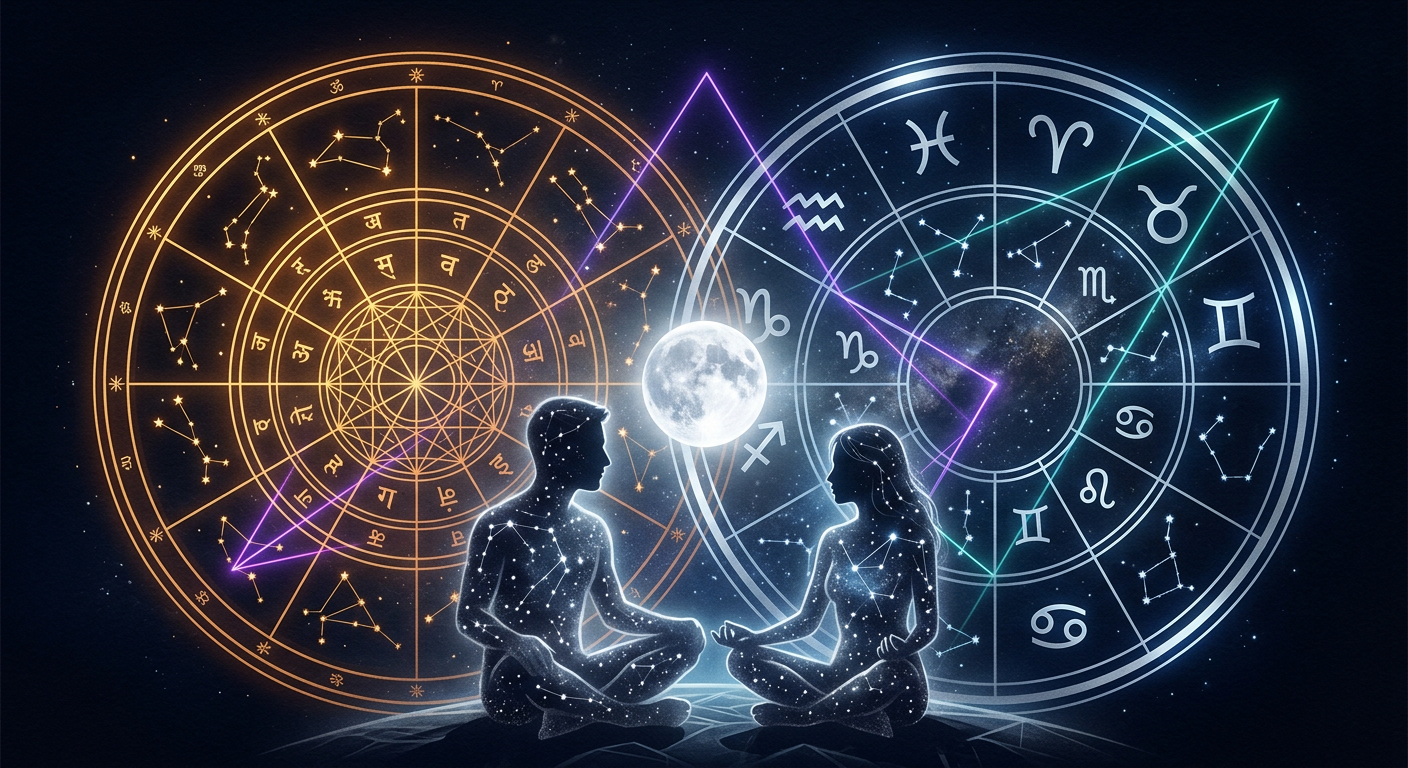
So you ran your compatibility on two different astrology sites and got completely different answers. One says your Moons are in harmonious Taurus and Virgo. The other says your Moon is actually in Aries. Now you're staring at the screen wondering if astrology is just chaos dressed up in celestial clothing.
It's not chaos. It's a jurisdiction problem.
Western and Vedic astrology are two distinct systems with different mathematical foundations, different frameworks for what 'Moon sign compatibility' even means, and — critically — different zodiacs. When you understand why they diverge, the conflicting readings start making sense. And when you understand what each system is actually measuring, you can use both to get a genuinely richer picture of emotional compatibility than either one gives you alone.
This is the explainer I wish existed when I first started comparing synastry chart analysis results across platforms.
Common Misconceptions About Moon Sign Compatibility
Myth 1: 'Vedic and Western astrology are basically the same thing with different names.'
Nope. They share ancient roots, but they diverged significantly in methodology. The zodiac calculation alone — tropical vs. sidereal — creates a gap of roughly 23 degrees between the two systems as of 2026. That's enough to shift your Moon sign entirely. The frameworks for interpreting compatibility are also structurally different: Western synastry is angle-based, Vedic compatibility is largely point-scored.
Myth 2: 'If my Vedic Moon score is high, we're compatible. If it's low, we're not.'
The Koota matching system (Guna Milan) gives you a number out of 36. People treat it like a compatibility percentage, which it isn't. A low score doesn't doom a relationship — it flags specific areas of tension. A high score doesn't guarantee happiness. It's a diagnostic tool, not a verdict.
Myth 3: 'The Moon matters more in one system than the other.'
The Moon matters enormously in both — but for different stated reasons. In Vedic astrology, the Moon is considered the primary indicator of mind, emotions, and inner life, and it anchors the entire birth chart interpretation. In Western astrology, the Moon represents emotional needs and unconscious patterns. Both systems agree the Moon is central to relationship compatibility. They just built different instruments to measure it.
Core Principles: How the Two Systems Actually Work
How Western and Vedic Astrology Calculate Your Moon Sign Differently
Here's the foundational thing to understand: both systems track the Moon's position against a backdrop of 12 zodiac signs. The disagreement is about where those signs begin.
Western astrology uses the tropical zodiac, which is anchored to the seasons. Aries always begins at the Spring Equinox (around March 20-21). This is a Sun-Earth relationship — it's about the Earth's orientation relative to the Sun.
Vedic astrology uses the sidereal zodiac, which is anchored to the actual constellations in the sky. Because of a phenomenon called axial precession (the Earth's slow wobble), the constellations have shifted relative to the equinoxes over thousands of years. The difference between these two systems — called the ayanamsa — is currently about 23-24 degrees.
What does that mean practically? If your Western Moon is at 10 degrees Taurus, your Vedic Moon is likely in Aries. Same Moon, same birth data, different sign. This is the single most common source of confusion for people cross-referencing compatibility results.
Tropical vs. Sidereal Zodiac: Why Your Moon Sign May Shift
The Moon moves fast — it changes signs every 2.5 days. So if you were born near the end of a sign in the tropical zodiac, the sidereal calculation will almost certainly place your Moon in the previous sign. People born in the middle of a sign have a smaller chance of shifting, but it still happens.
This isn't a bug in one system or the other. It's a feature of measuring different things. The tropical zodiac tracks seasonal energy cycles. The sidereal zodiac tracks stellar positions. Both are internally consistent. They're just different reference frames.
Vedic Nakshatra Compatibility: A Deeper Layer Beyond Rashi
Here's where Vedic astrology gets genuinely fascinating — and where it surpasses Western synastry in granularity for Moon-based compatibility.
In Vedic astrology, the Moon's position is analyzed not just by zodiac sign (Rashi) but by Nakshatra — one of 27 lunar mansions that divide the zodiac into segments of 13 degrees 20 minutes each. The Nakshatras are ancient. They predate the 12-sign zodiac in Indian astrological tradition and represent the Moon's daily journey through the sky over approximately one month.
Your Nakshatra is, in many ways, a more precise emotional fingerprint than your Moon sign. Two people can both have a Vedic Moon in Scorpio (Vrishchika), but if one is in Vishakha Nakshatra and the other is in Jyeshtha, their emotional temperaments and relational patterns will be quite different.
For moon sign compatibility analysis, Nakshatra compatibility is often more revealing than Rashi compatibility alone.
The 36-Point Koota Matching System
This is Vedic astrology's structured compatibility framework, and it's genuinely sophisticated. Koota matching (also called Ashtakoot Milan) evaluates eight categories of compatibility between two people's Moons — specifically their Nakshatras — and assigns points to each:
| Koota | Points Available | What It Measures |
|---|---|---|
| Varna | 1 | Spiritual/ego compatibility |
| Vashya | 2 | Mutual attraction and influence |
| Tara | 3 | Health, wellbeing, destiny |
| Yoni | 4 | Sexual and physical compatibility |
| Graha Maitri | 5 | Mental compatibility, friendship |
| Gana | 6 | Temperament and nature |
| Rashi (Bhakoot) | 7 | Emotional and financial harmony |
| Nadi | 8 | Health genetics, progeny |
Total possible: 36 points. Traditional guidance: below 18 is considered problematic, 18-24 is acceptable, 25-32 is good, 32+ is excellent. But — and I can't stress this enough — these thresholds are guidelines from classical texts, not algorithms. A skilled Vedic astrologer looks at which Kootas are low and why, not just the total score.
Guna Milan and Its Moon-Based Foundations
Guna Milan is sometimes used interchangeably with Koota matching, though technically Guna Milan refers to the broader principle of assessing compatibility through these matched qualities (gunas). The entire system is Moon-based — it uses your Janma Nakshatra (birth Nakshatra, determined by your Moon's position) as the input for every calculation.
This Moon-centricity is intentional. In Vedic philosophy, the Moon represents Manas — the mind, the emotional self, the reactive instincts. Compatibility at the Moon level is compatibility at the level of daily lived experience. It's not about grand romantic ideals (that's more Venus/Jupiter territory). It's about whether two people can actually cohabit their inner worlds without constant friction.
For a deeper look at how this plays out in practice, the analysis of moon sign soulmate pairings and emotional compatibility gets into some of the specific Nakshatra dynamics that make certain pairings feel fated.
Western Moon Sign Synastry: Aspects, Elements, and Modalities
Western synastry takes a completely different structural approach. Instead of scoring categories, it examines the angular relationship between two people's Moon signs and other planets.
The core tool is the aspect — the geometric angle between two points in different charts. Key Moon aspects in synastry:
- Conjunction (0°): Moons in the same sign. Intense emotional resonance — can feel like meeting yourself, which is either deeply comforting or claustrophobic depending on what you're both carrying.
- Trine (120°): Moons in the same element (both Fire, both Earth, etc.). Easy emotional flow, natural understanding, sometimes too easy — no productive friction.
- Sextile (60°): Compatible elements. Supportive, communicative, requires a little effort to activate.
- Square (90°): Moons in the same modality (both Cardinal, both Fixed, both Mutable) but incompatible elements. This is the aspect that produces the most growth — and the most arguments. Worth understanding before you dismiss it as a dealbreaker. (See also: difficult moon sign combinations in synastry for a full breakdown of what squares and oppositions actually mean in practice.)
- Opposition (180°): Moons in opposite signs. The classic push-pull dynamic. Frustrating and magnetic in equal measure.
Western synastry also analyzes which house one person's Moon falls into in the other's chart — this tells you where the emotional influence lands in daily life. Moon in the 7th house of a partner's chart, for instance, suggests a powerful one-on-one emotional bond.
Elements matter a lot in Western Moon compatibility. Fire Moons (Aries, Leo, Sagittarius) need enthusiasm and independence. Earth Moons (Taurus, Virgo, Capricorn) need stability and tangible expressions of care. Air Moons (Gemini, Libra, Aquarius) need conversation and intellectual connection. Water Moons (Cancer, Scorpio, Pisces) need emotional depth and safety.
And if you want to understand why certain Moon combinations create recurring emotional patterns, the synastry aspects explained article gets into the mechanics of how these angular relationships actually function.
Where Both Systems Agree on Lunar Compatibility
For all their methodological differences, Vedic and Western astrology converge on some key principles:
The Moon is the emotional core. Both systems treat the Moon as the primary indicator of how someone processes feelings, what they need to feel secure, and how they respond instinctively in relationships. This isn't coincidence — it's accumulated observation across cultures and centuries.
Emotional attunement is more important than surface attraction. Both systems prioritize the Moon's role in sustained compatibility over initial chemistry. Venus and Mars drive attraction. The Moon determines whether two people can actually live in emotional proximity over time.
Some combinations are inherently easier. Whether you're using Nakshatra compatibility or Western elements and aspects, certain pairings create natural resonance and others create friction. The specific pairings differ between systems, but the principle — that Moon-to-Moon compatibility exists on a spectrum — is consistent.
Context matters more than isolated scores. A single data point (one aspect, one Koota score) doesn't tell the whole story. Both traditions emphasize looking at the complete picture. In Vedic astrology, that means the full Koota analysis plus Dasha periods and chart overlays. In Western astrology, that means the full synastry chart plus composite and Davison chart analysis.
Practical Tactics: Using Both Systems
| Technique | Best Use | Outcome |
|---|---|---|
| Vedic Rashi Comparison | First-pass Vedic Moon sign check | Identifies basic elemental/sign compatibility in sidereal framework |
| Nakshatra Compatibility | Deep Vedic Moon analysis | Reveals temperament, instinct, and karmic compatibility at a granular level |
| Guna Milan Score | Structured Vedic compatibility assessment | 36-point diagnostic across 8 compatibility dimensions |
| Western Moon Aspects | Synastry angle analysis | Shows ease/friction patterns in emotional expression and needs |
| Moon House Overlays | Western synastry depth | Identifies where emotional influence lands in each person's life |
| Element Matching | Quick Western compatibility check | Flags natural resonance or tension in emotional temperaments |
| Combined Reading | Full cross-system analysis | Triangulates both systems for the most complete emotional compatibility picture |
Measuring Success: What Good Moon Compatibility Actually Looks Like
Both systems give you numbers and labels, but what are you actually measuring?
In Vedic astrology, a Guna Milan score above 18/36 is the traditional minimum for a compatible match. But research and practice suggest the distribution of points matters as much as the total. A couple scoring 20/36 with high Nadi (8 points) and Gana (6 points) has better fundamentals than one scoring 22/36 with low scores in both of those high-weighted categories.
In Western synastry, there's no single score — compatibility is assessed qualitatively. Benchmarks practitioners use:
- Moon trine or sextile Moon: High emotional ease baseline
- Moon conjunct Moon: Intense resonance, worth examining both charts' Moon conditions
- Moon square or opposite Moon: Friction present — look at whether other supportive aspects compensate
- Moon in partner's 4th, 7th, or 8th house: Strong emotional impact, positive or challenging depending on Moon's condition
One thing I've noticed across years of looking at these charts: a couple with 'difficult' Moon aspects but strong Saturn contacts (check out Saturn aspects in synastry for why Saturn is actually your friend here) often outlasts a couple with beautiful Moon trines and no stabilizing structure. Ease isn't the same as durability.
Future Trends in Moon Compatibility Analysis
A few things worth watching in 2026 and beyond:
Cross-system tools are getting better. Several astrology platforms now generate both tropical and sidereal charts simultaneously, making it easier to compare readings without switching tools. The demand for this is being driven by users who — exactly like you — got conflicting results and wanted to understand why.
Nakshatra-based compatibility is gaining traction in Western astrology circles. Western practitioners are increasingly incorporating Nakshatra analysis into synastry work, treating it as a supplementary layer rather than a competing system. This is a genuinely useful development.
AI-assisted chart interpretation is expanding access. More people are getting detailed Moon compatibility readings without needing a professional astrologer for every question. But the limitation is real: AI tools are only as good as the astrological frameworks they're trained on, and nuanced Koota analysis still benefits from human expertise.
The conversation between systems is maturing. A decade ago, most Western astrologers dismissed Vedic methods and vice versa. Now there's more cross-pollination, more practitioners trained in both, and more clients who want the full picture. That's good for everyone trying to understand their emotional patterns in relationships.
What to Do Next
If you've been getting conflicting Moon compatibility results, start here: pull your chart in both tropical and sidereal formats and note where your Moon actually lands in each system. That single step explains most of the confusion.
Then, instead of picking a winner between Vedic and Western, treat them as complementary lenses. Run your Nakshatra compatibility and Guna Milan score for the Vedic view. Run your Moon aspects and house overlays for the Western view. Where both systems flag harmony, you've got a strong signal. Where they diverge, you've got nuance worth exploring.
And if you want a structured way to do that, a proper synastry chart analysis that covers both frameworks is genuinely worth the time — it surfaces patterns that neither system catches alone.
The Moon doesn't change because you're using a different zodiac. Your emotional needs are the same in any coordinate system. The goal of all this analysis is just to see them more clearly.