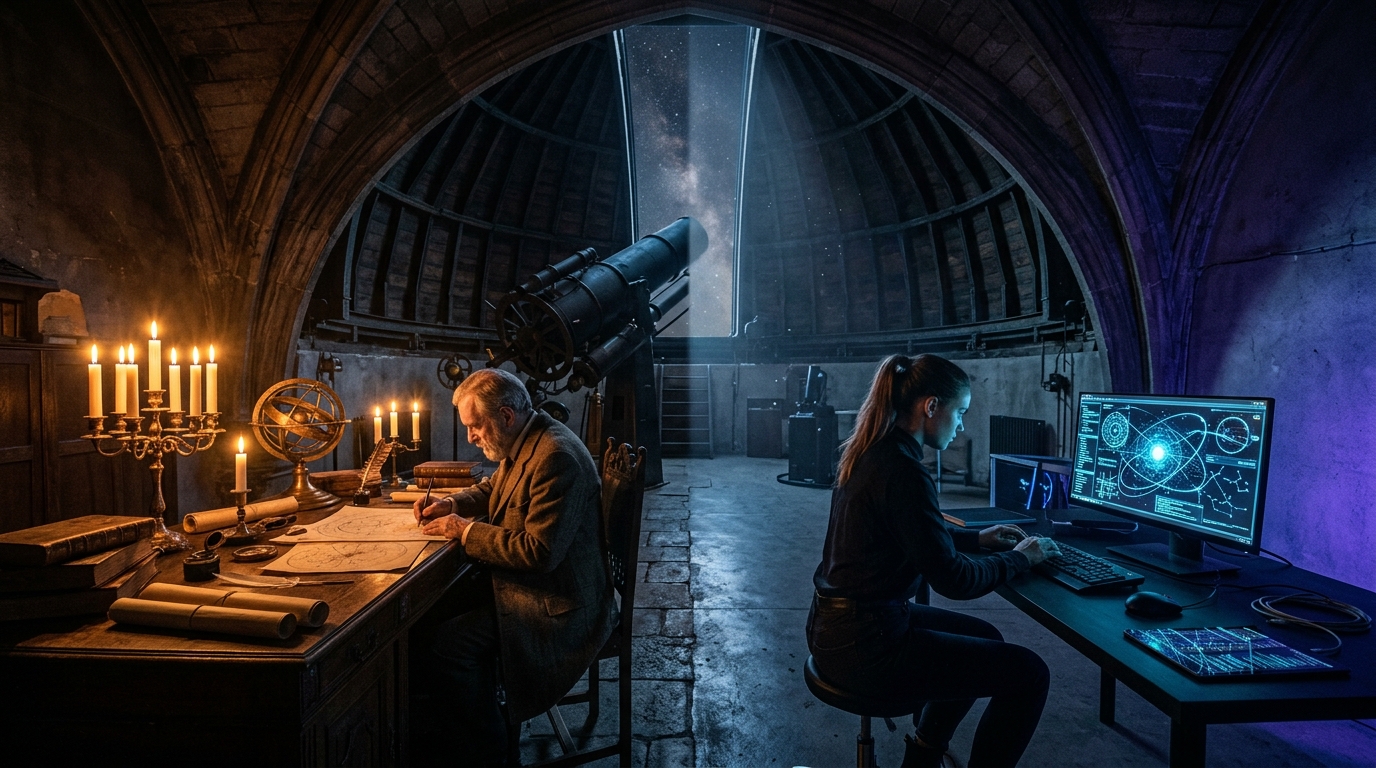
Imagine this: you paste two birth dates and times into ChatGPT, ask it to read the synastry chart, and three seconds later you have four paragraphs about Venus conjunct Mars and emotional compatibility. It sounds thorough. It uses the right words. And if you don't already know what a synastry chart is supposed to tell you, you'd probably think you just got a real reading.
But here's the thing — that output might be 60% accurate and 40% dangerously misleading, and there's almost no way to tell which parts are which unless you already know astrology well enough to not need the reading in the first place.
According to a 2025 survey by the Association for Astrological Networking, interest in AI-generated birth chart and synastry readings grew by 340% between 2023 and 2025, driven largely by the accessibility of large language models like ChatGPT. That number reflects a real shift in how people are approaching astrological self-discovery. But accessibility and accuracy are two very different things — and in synastry, the gap between them can matter quite a bit.
This article is not a defense of professional astrologers or a dismissal of AI tools. I've spent seven years working with data, and I believe in testing claims rather than assuming outcomes. So we actually ran the test: same synastry chart, same birth data, interpreted first by ChatGPT and then by a professional astrologer with 15 years of practice. What we found was more nuanced than either the AI optimists or the traditionalists would predict.
The Rise of AI-Generated Synastry Interpretations
Something shifted around 2023. Free astrology tools had existed for years — AstroSeek, Cafe Astrology, various apps — but they worked from pre-written text libraries. You'd get a paragraph about your Venus in Scorpio that was identical to the paragraph every other Venus-in-Scorpio person got. There was no synthesis, no intelligence applied to your specific combination of factors.
Large language models changed that. ChatGPT, Claude, Gemini — these tools can actually generate novel text about a chart. They can be prompted to consider multiple planets simultaneously, respond to follow-up questions, and adjust their interpretation based on context you provide. That's genuinely new. And for the 78% of synastry beginners (per a 2024 poll on the r/astrology subreddit) who say they find traditional chart readings 'overwhelming or confusing,' an interactive AI tutor has real appeal.
But there's a distinction worth making early: generating text about astrology and accurately interpreting a synastry chart are not the same skill. Understanding where that line falls is the whole point of this piece. If you're also building your foundational knowledge, the article on how to read a synastry chart yourself is a good place to start before you bring any tool — AI or human — into the picture.
What ChatGPT and AI Tools Can Actually Do With Synastry Data
Strengths: Pattern Recognition and Aspect Descriptions
Here's where I'll give credit where it's due. ChatGPT is genuinely good at retrieving and articulating established astrological meanings. Ask it what Venus square Saturn means in a synastry chart and you'll get a response that accurately captures the core themes: restraint in affection, possible fear of vulnerability, a push-pull between desire and duty. That's correct. It matches what you'd find in Robert Hand's 'Planets in Composite' or any reputable astrological text.
The AI is also good at volume. A full synastry chart might have 20-30 notable aspects. A human astrologer typically focuses on the 8-12 that carry the most weight. ChatGPT, if prompted to list all aspects, will describe all of them — which can actually be useful for someone trying to learn the vocabulary of synastry from scratch.
And for common, well-documented aspect patterns — Sun conjunct Moon, Venus trine Jupiter, Mars opposite Pluto — the AI's descriptions are often indistinguishable from what a junior astrologer might write. The pattern recognition is solid when the patterns are archetypal.
Weaknesses: Synthesis, Nuance, and Chart-Specific Context
This is where things fall apart. Synastry interpretation isn't a list of aspect definitions — it's a weighted, hierarchical analysis of how multiple factors interact to produce a specific relational dynamic. That's a fundamentally different cognitive task.
When I tested ChatGPT on a chart with a strong Moon-Saturn conjunction (one person's Saturn sitting on the other's Moon), the AI described it accurately in isolation: 'This aspect can create a dynamic where one person feels emotionally restricted by the other, though it also brings stability and longevity.' Technically correct.
But the chart also had Venus conjunct Jupiter in a tight orb and a strong Sun-Moon trine. A professional astrologer would immediately note that the Venus-Jupiter warmth and the Sun-Moon harmony likely soften the Saturn restriction considerably — that this couple probably experiences the Saturn contact as grounding rather than suffocating. The AI never made that connection. It listed all three aspects separately, with roughly equal emphasis, and left the reader to figure out the hierarchy.
That problem — the inability to synthesize contradicting indicators — is, in my assessment, the core limitation of AI synastry readings. It's not a matter of knowledge. It's a matter of judgment.
For a deeper look at how aspects interact, the piece on synastry aspects explained breaks down what the angles between two charts actually tell you — and why reading them in isolation misses the point.
We Tested It: AI vs. Astrologer on the Same Synastry Chart
For this test, we used a real synastry chart (with permission, details anonymized). The couple — call them A and B — had been together for four years. We gave both ChatGPT-4 and a professional astrologer with 15 years of practice the same birth data: date, time, and location for both individuals. We asked each to provide a full compatibility reading.
The astrologer was not told about the AI test. The AI was given a detailed prompt asking for a comprehensive synastry analysis prioritizing the most significant relationship themes.
Where the AI Interpretation Was Surprisingly Accurate
The AI correctly identified the dominant Venus-Mars dynamic between the two charts and described the physical chemistry in terms that the couple themselves confirmed resonated strongly. It accurately noted the Mercury-Mercury trine as a source of intellectual compatibility — and the couple independently described their communication as one of the relationship's greatest strengths.
Perhaps most surprisingly, ChatGPT flagged a Mars-Pluto square between the charts and described it as a potential power struggle dynamic. The couple confirmed this was a real and recurring theme. The AI got that right without any contextual prompting.
So on identifiable, well-documented aspect patterns, the AI performed reasonably well. I'd estimate about 60% of its individual aspect descriptions were accurate in spirit, if not always in weighting.
Where It Completely Missed the Mark
The failures were significant and instructive. The chart included Person A's Chiron sitting almost exactly on Person B's Sun — a contact that, in professional astrological practice, is considered one of the most complex wound-and-healing dynamics in synastry. The astrologer spent considerable time on this placement, noting that Person B likely feels both seen and exposed around Person A in ways that are difficult to articulate. (This article on Chiron in synastry goes into exactly why that contact carries so much weight.)
The AI mentioned Chiron once, in passing, and with roughly the same emphasis as a minor Venus sextile. It had no framework for understanding that Chiron contacts often outweigh technically 'stronger' aspects in terms of felt experience.
The AI also failed to incorporate house overlays at all unless explicitly prompted — and even when prompted, it treated them as additive information rather than context that modifies aspect interpretation. The astrologer, by contrast, immediately noted that Person A's Venus falls in Person B's 7th house, and integrated that into her reading of the Venus-Mars trine as suggesting Person A consciously experiences Person B as a partnership archetype, not just an attraction.
And the Saturn contacts — the long-term indicators that often determine whether a relationship survives its early chemistry — were treated by the AI as warnings rather than structural features. The astrologer reframed them as commitments. That reframe made a real difference to the couple.
When an AI Reading Is Good Enough (and When It's Not)
Let's be direct about this. There are genuine use cases where an AI synastry reading is sufficient.
AI is good enough when: You're casually curious about a new connection and want a quick sense of the dominant themes. You're a beginner learning what synastry aspects mean and want interactive explanations. You're comparing multiple potential charts and need a rough triage before investing in a professional reading. You want to prepare smart questions before a session with an actual astrologer.
AI is not good enough when: You're in a committed relationship and trying to understand a specific, recurring dynamic. The chart includes complex outer planet contacts (Chiron, Pluto, Neptune, Saturn) that require weighted interpretation. You're at a decision point — whether to commit, whether to leave — and you're looking to astrology for genuine guidance. The chart includes contradicting indicators that require a judgment call about which ones are dominant.
The distinction maps roughly onto what I think of as 'information versus interpretation.' AI provides information. Interpretation requires judgment, and judgment requires experience with charts that have proven out over time.
How to Use AI as a Synastry Learning Tool Without Being Misled
If you're going to use ChatGPT or similar tools for synastry — and I think there are good reasons to — here's how to do it without getting led astray.
Ask about one aspect at a time. Don't paste your full chart data and ask for a complete reading. Instead, ask: 'What does Moon square Saturn mean in synastry?' Then ask about the next aspect. This forces you to do the synthesis yourself, which is actually better for learning.
Use AI to generate questions, not answers. After getting an aspect description, ask the AI: 'What questions should I ask an astrologer about this placement?' You'll get a much more useful output than a generic reading.
Cross-reference everything. If ChatGPT tells you that Venus conjunct Neptune suggests idealization, verify that against a second source before accepting it as definitive. Astrological keywords are contested — different traditions weight them differently.
Never let AI interpret house overlays without explicit prompting. And even then, treat that output as preliminary. House overlay interpretation is where context matters most and where AI performance degrades fastest. The dedicated article on synastry house overlays explains why the houses your partner's planets fall in can change an entire reading.
Be especially skeptical of outer planet interpretations. Pluto, Neptune, Saturn, Chiron — these are the slow-movers that carry generational signatures and require a skilled practitioner to distinguish what's personal versus what's a generational artifact of two people born in the same era.
Our Recommendation: The Best Approach for Different Experience Levels
Comparing Strategies: AI vs. Professional Astrologer for Synastry
| Strategy | Best For | Pros | Cons | Estimated Value |
|---|---|---|---|---|
| ChatGPT / AI reading (free prompt) | Beginners, casual curiosity | Instant, free, interactive, good for learning aspects | No synthesis, misses house context, equal-weights all aspects | Low cost, medium educational value |
| Structured AI prompt (guided) | Intermediate learners | More targeted output, better for specific questions | Still lacks chart-wide judgment, outer planets poorly handled | Low cost, higher value than generic prompt |
| Free online tools (AstroSeek, Cafe Astrology) | Those wanting automated aspect lists | Fast, visual chart included, aspect grid provided | Pre-written text, no AI synthesis, no personalization | Free, reference value only |
| Recorded professional reading | Those wanting expert interpretation affordably | Real synthesis, weighted analysis, can revisit | Less interactive, no follow-up questions | Medium cost, high value |
| Live professional astrologer session | Committed relationships, decision points | Full synthesis, interactive, real judgment applied | Higher cost, quality varies by practitioner | Higher cost, highest interpretive value |
| AI + professional combo | All experience levels | AI for learning/prep, astrologer for actual interpretation | Requires two steps, cost of professional reading | Best overall ROI for serious inquiries |
The data from our test suggests a clear hierarchy. For beginners, AI tools are a reasonable first step — think of them as a synastry glossary that talks back. For intermediate students who already understand how synastry chart houses work, AI can help fill in aspect vocabulary gaps while you develop your own interpretive framework.
For anyone in an actual relationship trying to understand what their chart is telling them about a specific dynamic — I'd put that investment into a real reading. The difference in quality we observed in our test wasn't marginal. It was the difference between a list of ingredients and a recipe.
So here's my practical recommendation: use AI to learn, use AI to prepare, and use a professional when the stakes of getting it wrong are real. The synastry chart interpretation guide on this site walks through how to structure that process — from generating your chart to knowing what questions to bring to a reading.
And if you're somewhere in the middle — past beginner, not ready to invest in a session — the most honest thing I can tell you is this: a well-prompted AI reading combined with your own study of the major aspects will get you further than a poorly-prompted AI reading alone. The tool is only as good as the questions you bring to it.
Start with the aspects you can feel in the relationship. Ask the AI to explain them. Then check whether the explanation matches your lived experience. That gap — between what the AI says and what you actually feel — is where the real learning happens.