Most people who land on a synastry tool already have a relationship in mind. They're not idly curious about astrology — they want to know something specific, and they want to know it now. The question is whether the tool they're using can actually answer it.
Cafe Astrology and AstroSeek are the two most-used free synastry resources on the internet, and they serve genuinely different purposes. Neither one is wrong to use. But both have a ceiling, and understanding where that ceiling sits will save you from misreading your own chart.
What Cafe Astrology's Synastry Report Actually Gives You
Cafe Astrology has been around long enough that its URL shows up in astrology forums from 2007. That longevity isn't nostalgia — it reflects the fact that the site built something genuinely useful: written interpretations of synastry placements that are accessible to beginners without being condescending.
When you run a synastry report on Cafe Astrology, you get a list of inter-aspects between two charts — Venus conjunct Mars, Moon square Saturn, Sun trine Jupiter — each followed by a paragraph or two of written interpretation. No chart wheel. No degree orbs displayed. Just the aspects and what they're said to mean.
Strengths: What It Gets Right
The writing quality is above average for free tools. The interpretations are specific enough to feel meaningful — they're not just "this aspect brings harmony" filler. A Moon-Saturn square, for instance, gets a real treatment: the emotional withholding, the dynamic where one person feels criticized, the possibility of stability alongside restriction.
For someone who has never read a synastry chart before, this format is genuinely helpful. You don't need to know what a trine is. You just read the description and decide whether it resonates.
The site also covers a solid range of planets and points — Sun, Moon, Mercury, Venus, Mars, Jupiter, Saturn, Uranus, Neptune, Pluto, and the Ascendant. That's enough to get a real picture of the core relational dynamics.
Limitations: What the Report Can't Tell You
Here's where it gets complicated. Cafe Astrology's interpretations treat each aspect in isolation. Your Venus conjunct their Mars gets its paragraph. Your Moon square their Saturn gets its paragraph. But those two aspects interact — and the report doesn't tell you how.
A Venus-Mars conjunction between two people who also have Moon-Saturn tension is a very different story than the same conjunction between two people with Moon-Jupiter trines everywhere. The first might burn hot and feel emotionally unsafe. The second might be genuinely sustaining. The individual aspect descriptions won't surface that difference.
Orbs are another gap. Cafe Astrology doesn't display the degree of separation between aspecting planets, which means you can't tell whether a given aspect is exact (powerful) or wide (background noise). An 8-degree Venus-Mars conjunction reads the same as a 1-degree one in the report — but in practice, they're not remotely the same.
And the site doesn't cover synastry house overlays at all. Where one person's planets fall in the other's houses is arguably as important as the inter-aspects themselves — it determines the arena of life where that planet's energy gets expressed. That entire layer is absent.
What AstroSeek's Synastry Calculator Does Differently
AstroSeek takes a different philosophy: show the astrologer everything, interpret as little as possible. The result is a tool that rewards people who already know what they're looking at.
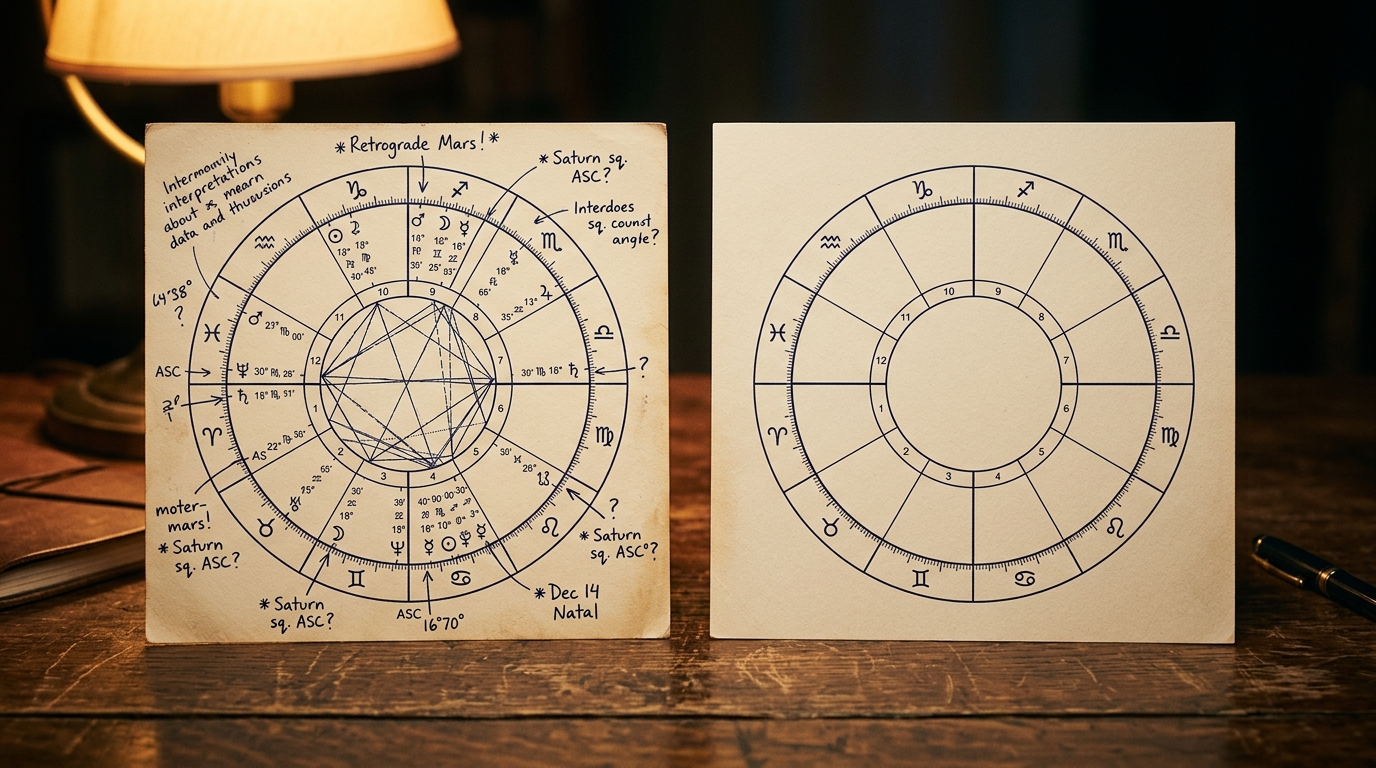
The synastry calculator on AstroSeek generates a full bi-wheel chart — both natal charts overlaid on each other — plus a comprehensive aspect grid showing every inter-aspect with exact degree orbs. You can see whether that Venus-Mars aspect is 0°47' or 7°12'. That distinction matters.
Strengths: Depth of Chart Data
The sheer volume of data AstroSeek provides is its main advantage. Beyond the standard planets, you can include asteroids, Arabic parts, Chiron, the Nodes, and various house systems. If you want to see where someone's Chiron falls in relation to your Moon — a placement associated with deep emotional wounding and healing in relationships — AstroSeek will show you that, with the exact orb.
The aspect grid is particularly useful. You can scan it quickly to identify the dominant themes: is this chart heavy in Saturn contacts (commitment, but also restriction)? Is there a Venus-Neptune thread running through it (romantic idealization, possible illusion)? Patterns emerge from the grid in a way they don't from a list of written descriptions.
AstroSeek also handles house overlays — you can see which of your planets land in which of your partner's houses, and vice versa. That's a significant advantage over Cafe Astrology for anyone who wants a complete picture of how two charts interact.
Limitations: Data Without Interpretation
The problem is that AstroSeek gives you a cockpit full of instruments and no flight manual.
If you don't already know that a Moon-Pluto conjunction in synastry signals intensity and possible power dynamics, the aspect grid won't tell you. If you don't know that Saturn in someone's 7th house overlay carries different weight than Saturn in their 5th, the chart won't explain it. The data is all there — but data isn't meaning.
For beginners, an AstroSeek synastry chart can be paralyzing. There are dozens of aspects, many of them seemingly contradictory. You might have a beautiful Venus trine Moon and a Mars square Saturn. Which one wins? (Neither — they both operate, in different contexts, at different times. But the chart won't tell you that.)
The written interpretations AstroSeek does include are brief to the point of being nearly useless — a sentence or two per aspect, often generic. They're placeholders more than explanations.
Side-by-Side: Cafe Astrology vs. AstroSeek for Synastry
| Feature | Cafe Astrology | AstroSeek |
|---|---|---|
| Written interpretations | Detailed paragraphs | One-line summaries |
| Aspect orbs shown | No | Yes, exact degrees |
| Bi-wheel chart visual | No | Yes |
| House overlays | No | Yes |
| Asteroid/minor planet support | Limited | Extensive |
| Beginner-friendly | High | Low |
| Useful for experienced readers | Moderate | High |
| Synthesis across aspects | No | No |
That last row is the one that matters most.
The Problem Both Tools Share (and Why It's Not Their Fault)
No automated synastry tool — not Cafe Astrology, not AstroSeek, not any of the paid apps that have launched in the last five years — can synthesize a chart. That's not a criticism. It's a structural limitation of what software can do.
Synthesis is the act of reading a chart as a whole: weighing which aspects are most powerful given their orbs and the planets involved, identifying the recurring themes that run across multiple placements, and understanding how the tensions and harmonies in a chart interact with each other. It's the difference between reading individual words and understanding what a sentence means.
Consider a chart where one person's Saturn conjuncts the other's Sun (exact, 0°23') and their Venus trines the other's Moon (wide, 6°40'). An automated tool gives both aspects roughly equal treatment. An experienced astrologer immediately knows the Saturn-Sun contact dominates — it's tighter, it involves a personal planet, and Saturn-Sun synastry has a specific psychological signature around authority and self-expression that shapes the entire relationship. The Venus-Moon trine is real and warm, but it's operating in the shadow of that Saturn contact.
That kind of reading requires judgment. It requires knowing what the aspects in your generated chart actually mean in context — not just in isolation.
The tools aren't failing when they skip synthesis. They were never designed to do it. The failure mode is when users treat the output as complete analysis rather than raw material.
There's another layer automated tools miss: timing and lived experience. A Saturn square in synastry reads differently for a 24-year-old in their first serious relationship than for a 45-year-old who has already done significant personal work around boundaries and self-worth. The chart is the same. The meaning isn't.
And then there are the questions people actually bring to synastry charts. Not "what does this aspect mean" but "we keep having the same fight — is that in the chart?" or "this relationship feels fated, is that real or am I projecting?" Those questions require someone who can look at the whole picture — including the North Node contacts that often signal karmic significance — and give a considered answer.
What to Do Once You Have Your Chart
Run both tools. Seriously. Use Cafe Astrology first if you're newer to synastry — the written interpretations give you vocabulary and context for what you're looking at. Then pull up AstroSeek to see the full chart with orbs, check the house overlays, and look for patterns in the aspect grid that the written report might have glossed over.
Pay attention to:
- Exact aspects (under 2° orb) — these are the defining contacts of the relationship
- Repeated themes — if Saturn shows up in three different inter-aspects, that's a through-line, not a footnote
- The Moon's connections — emotional compatibility runs through the Moon, and Moon aspects in synastry often describe the day-to-day texture of a relationship more accurately than Sun aspects do
- House overlays — especially where the other person's personal planets (Sun, Moon, Venus, Mars) fall in your chart
But after you've done that work, you'll likely find yourself sitting with a chart that raises more questions than it answers. That's not a flaw in the tools — it's the nature of synastry. The chart maps the terrain. It doesn't tell you how to walk it.
The logical next step isn't more software. It's a conversation with someone who has read hundreds of these charts and can look at yours specifically — not a generic interpretation of Venus trine Moon, but what your Venus trine their Moon means given everything else in the chart.
If you're at that point, connect with a synastry specialist who reads charts, not just generates them. The difference between having data and having understanding is exactly that conversation.
The tools gave you the map. Now it's worth figuring out what it's actually telling you.