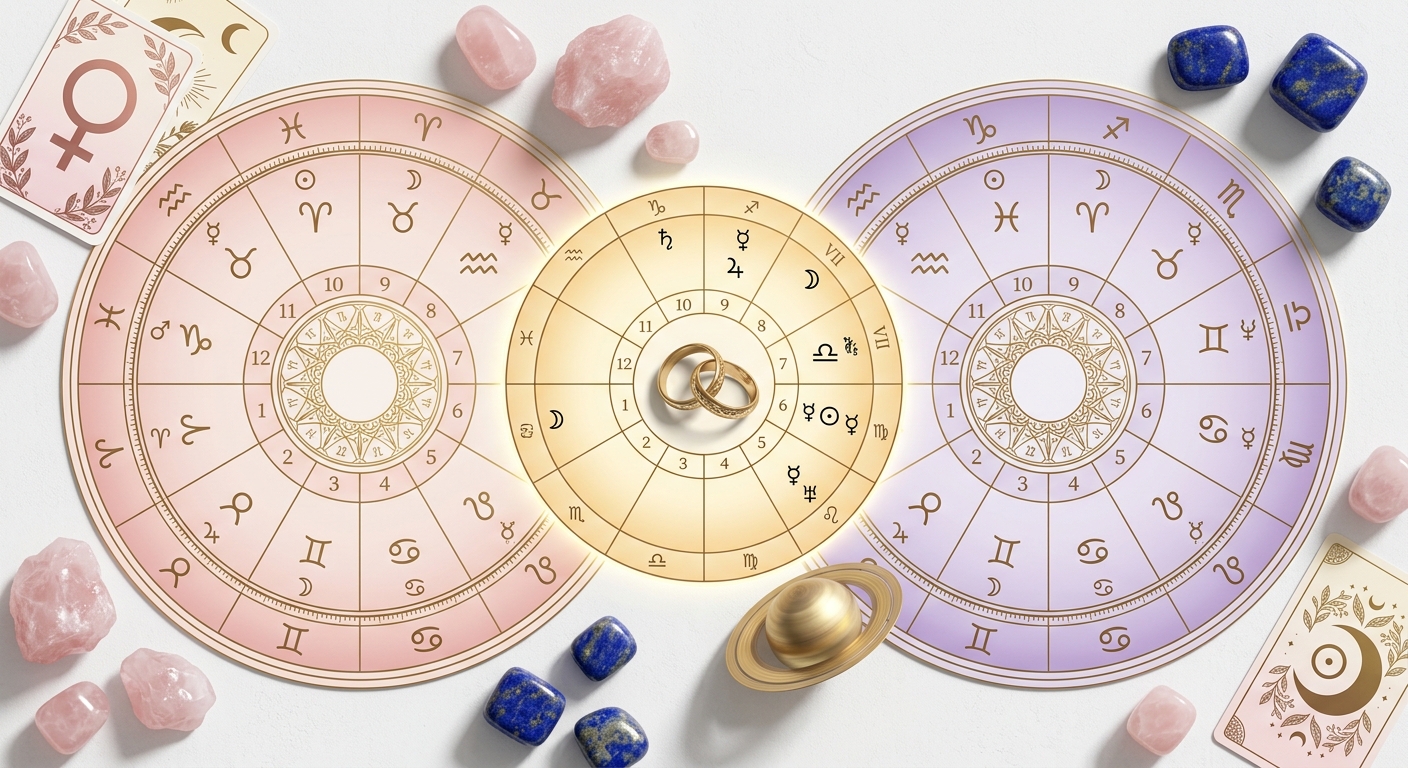
Davison Chart Marriage Indicators: Aspects and Placements That Signal Long-Term Commitment
Some couples just feel like a unit. You meet them at a dinner party and there's this quiet, settled energy between them — like they've been orbiting each other for centuries. If you pull their Davison chart, more often than not, you'll find a very specific set of patterns that explain exactly why.
The Davison chart is one of astrology's most underused tools for relationship analysis. Unlike synastry, which overlays two individual charts, the Davison creates a single chart for the relationship itself — a third entity with its own planetary positions, house placements, and aspects. And when you know what to look for, it can tell you a remarkable amount about whether a partnership is built for the long haul.
This isn't a guide about generic 'good vibes' aspects. We're going to get specific: which Saturn placements create structural commitment, what the 7th house ruler's dignity actually means, and how angular house emphasis correlates with marriages that last decades. If you're already familiar with Davison chart interpretation, this is where we go deeper.
Common Misconceptions About Davison Marriage Indicators
Before we get into what actually works, let's clear out some of the noise.
Myth #1: More Venus aspects = more love = more marriage potential. This one's everywhere, and it's misleading. Venus aspects in the Davison chart describe the quality of affection and aesthetic harmony between two people — but affection alone doesn't build a 25-year partnership. I've seen Davison charts with gorgeous Venus trines and absolutely no Saturn structure, and those relationships often burn bright and fizzle fast.
Myth #2: Challenging aspects mean the relationship won't last. Not even close. Some of the most enduring marriages I've analyzed have Davison charts with Mars square Saturn or Venus opposite Pluto. Tension creates investment. It's the type of challenge that matters, not the presence of one.
Myth #3: The 7th house is the only house that matters for marriage. The 7th house is absolutely central, but angular houses (1st, 4th, 7th, and 10th) all contribute to whether a relationship takes on a public, committed, structural form. A stellium in the 10th, for instance, can indicate a partnership that becomes socially recognized — which often includes marriage.
Core Principles for Reading Davison Marriage Indicators
Here are the foundational principles I work from when assessing marriage potential in a Davison chart.
1. Angular emphasis matters more than aspect count. Planets in the 1st, 4th, 7th, and 10th houses of the Davison chart carry enormous weight. These houses represent identity, home, partnership, and public life — the four pillars of a committed life together. A Davison chart with multiple planets in angular houses almost always describes a relationship that becomes structurally significant in both people's lives.
2. Saturn is your best friend, not your enemy. Saturn in the Davison chart is the commitment architect. It slows things down, yes. It adds weight and responsibility. But those are features in a long-term partnership, not bugs. Research in relationship astrology consistently points to Saturn contacts as one of the most reliable markers of durability. (There's a reason Saturn aspects in synastry are so worth studying — the same logic applies here.)
3. The 7th house ruler's condition is diagnostic. Where is the ruler of the Davison 7th house? Is it dignified, debilitated, or in a powerful house? A well-placed, dignified 7th house ruler suggests the relationship naturally flows toward partnership as its highest expression. A debilitated or poorly aspected ruler doesn't doom the relationship, but it signals friction in the commitment dynamic.
4. Sun-Moon aspects describe the relationship's emotional core. The Sun and Moon in the Davison chart represent the couple's identity and emotional life as a unit. When they're in harmonious aspect, there's an intuitive ease — both people feel like the relationship 'gets' them. When they're in hard aspect, there can be a push-pull between the couple's public face and their private emotional reality.
5. Look at the whole chart, not just the highlights. No single aspect or placement seals the deal. Marriage indicators in the Davison chart are cumulative. Three or four strong indicators? That's meaningful. One Jupiter in the 7th with nothing else supporting it? Interesting, but not conclusive.
Saturn Aspects in the Davison Chart: The Commitment Backbone
Let's talk about Saturn, because this is where most people get it wrong.
Saturn Conjunct Venus or Moon: Duty Meets Devotion
When Saturn conjuncts Venus in the Davison chart, the relationship has a quality of chosen commitment — love that's been tested and decided upon, not just felt. It can feel serious from the start, sometimes even heavy. But that gravity is what makes it lasting. Partners often describe the relationship as feeling 'important' or 'real' in a way their other relationships didn't.
Saturn conjunct Moon is even more profound for long-term potential. The Moon governs emotional needs and daily rhythms. Saturn here creates a relationship where emotional support becomes a structure — regular, reliable, and deeply felt over time. It's not the most romantic-sounding combination, but couples with this placement often say they feel genuinely safe with each other in a way that's rare.
Saturn in Angular Houses: Structural Stability
Saturn in the 1st house of the Davison chart gives the relationship a serious, enduring identity. People around them sense the permanence. Saturn in the 4th suggests the relationship is built around home, family, and shared roots — the classic foundation for a domestic partnership. Saturn in the 7th (yes, Saturn ruling its own natural domain here) is one of the clearest marriage indicators in the entire chart. And Saturn in the 10th? That's a relationship that becomes part of both people's public legacy.
So don't fear Saturn placements. Welcome them.
Venus and Jupiter Placements That Indicate Lasting Love
Venus and Jupiter bring warmth, expansion, and joy to the Davison chart — and in the right positions, they strongly support long-term commitment.
Venus in the 7th house of the Davison chart is the most classically recognized marriage indicator. It places love, harmony, and aesthetic appreciation directly in the house of partnership. But here's what I think is more telling: Venus's dignity. Venus in Taurus or Libra (its domiciles) in the Davison 7th is a genuinely powerful indicator. Venus in Aries or Scorpio (its detriment) in the same position can create attraction that's complicated by power dynamics or volatility.
Jupiter in the Davison chart brings expansion and optimism to wherever it lands. Jupiter in the 7th expands the couple's sense of what partnership can be — often indicating a relationship that feels abundant and growth-oriented. Jupiter conjunct the Davison Ascendant or Midheaven can indicate a relationship that is publicly celebrated or socially significant, which often coincides with formal commitment.
And Jupiter-Venus conjunctions or trines in the Davison chart? Those are genuinely lovely. They create an atmosphere of generosity and mutual appreciation that sustains a relationship through the harder seasons.
The 7th House in the Davison Chart: Partnership as Destiny
The 7th house is the relationship's center of gravity for committed partnership. In the Davison chart, it represents what the relationship is at its core — its defining purpose and relational identity.
Planets in the 7th House and What They Mean
- Sun in the 7th: The relationship's identity is fundamentally about partnership. Both people define themselves partly through this union.
- Moon in the 7th: Emotional security comes through commitment. The relationship has a nurturing, domestic quality.
- Venus in the 7th: Love and harmony are central to the relationship's purpose. A classic marriage indicator.
- Jupiter in the 7th: The relationship expands both people's lives. Often indicates a partnership that feels fated or abundant.
- Saturn in the 7th: Commitment is taken seriously. The relationship may form slowly but lasts. One of the strongest structural marriage indicators.
- Mars in the 7th: Passion and drive are central, but so is potential conflict. Durable if channeled productively.
- Pluto in the 7th: Transformative commitment. The relationship changes both people profoundly. Intense, potentially difficult, but rarely superficial.
7th House Ruler Aspects and Dignity
This is where I see most astrologers stop short — they note what's in the 7th house but don't follow the ruler. Find the sign on the Davison 7th house cusp, identify its ruling planet, and then ask: Where is that planet? What is it aspecting? Is it dignified?
A 7th house ruler in the 1st or 4th house, well-aspected, suggests the relationship naturally evolves toward committed domestic partnership. A 7th house ruler conjunct the Davison Sun or Moon adds enormous weight to the marriage potential. If you're curious about how to calculate the Davison chart itself before doing this analysis, this guide on how the Davison chart is calculated walks through the mechanics clearly.
Sun-Moon Aspects: Emotional and Identity Alignment
In the Davison chart, the Sun represents the couple's shared identity and purpose — the 'face' they present to the world together. The Moon represents their emotional life as a unit, their private rhythms and needs.
When the Davison Sun and Moon are conjunct, the relationship has a powerful sense of unity. Identity and emotion move together. This can feel almost fated — like the relationship is the two people's combined essence.
Sun trine or sextile Moon in the Davison chart creates easy flow between the couple's public identity and private emotional life. These relationships tend to feel comfortable and natural, even early on. And that ease is a genuine asset for long-term commitment — it reduces the friction that erodes partnerships over decades.
Sun square or opposite Moon doesn't eliminate marriage potential, but it does indicate tension between who the couple is publicly and what they need emotionally. These partnerships often require more conscious work to bridge that gap. (Understanding the emotional layer of compatibility is worth exploring through Moon sign compatibility as a companion read.)
Practical Tactics for Identifying Davison Marriage Indicators
| Technique | Best Use | Outcome |
|---|---|---|
| Check angular house emphasis | First pass — count planets in 1st, 4th, 7th, 10th | Establishes structural weight of the relationship |
| Assess Saturn's house and aspects | Identify commitment architecture | Reveals durability and seriousness of the bond |
| Evaluate 7th house ruler's dignity | Intermediate analysis | Diagnoses ease or friction in the partnership dynamic |
| Examine Sun-Moon aspect | Emotional core assessment | Shows alignment between identity and emotional needs |
| Note Venus and Jupiter placements | Quality of love and expansion | Indicates warmth, generosity, and growth potential |
| Look for mutual reception between planets | Advanced technique | Strengthens the indicators already present |
| Cross-reference with synastry aspects | Final synthesis | Confirms or complicates Davison findings |
Challenging Indicators: When the Davison Chart Warns Against Marriage
Honesty matters here. Not every Davison chart points toward marriage, and recognizing the challenging indicators is just as important as celebrating the positive ones.
Saturn square or opposite the Davison Ascendant can indicate a relationship that feels constraining or burdensome over time — like the partnership limits both people rather than supporting them.
A debilitated 7th house ruler in the 12th house is one I watch carefully. The 12th house governs hidden things, self-undoing, and isolation. A 7th house ruler there can suggest a relationship that stays hidden, struggles to become formally committed, or involves sacrifice that becomes unsustainable.
Neptune square Venus or the 7th house ruler can indicate idealization that eventually collapses. These relationships often feel magical early on but may be built on projections rather than reality. That's not always fatal — but it requires both people to do real work seeing each other clearly.
Uranus conjunct the Davison Descendant often describes a relationship that values freedom over commitment. These partnerships can be electric and meaningful but may resist the structure that formal marriage requires.
Look, challenging indicators don't mean 'don't marry this person.' They mean 'here's where you'll need to be intentional.' That's genuinely useful information.
Real Chart Examples: Davison Charts of Long-Term Marriages
Without naming specific individuals (privacy matters, even for public figures), here are the patterns I see repeatedly in Davison charts of couples married 20+ years:
Pattern 1: Saturn in or ruling the 7th, with Venus in an angular house. This combination appears in a striking number of long-term marriages. Saturn provides the structure; Venus provides the warmth that makes that structure feel like home rather than a prison.
Pattern 2: Sun-Moon conjunction or trine, with Jupiter in the 7th or 1st. These couples describe their relationship as their 'home base' — the place they return to emotionally regardless of what life throws at them. Jupiter's presence expands that sense of belonging.
Pattern 3: Multiple planets in the 4th house, including one of the luminaries. The 4th house governs home, roots, and family. When the Davison chart emphasizes this house, the relationship is fundamentally about building a life together — shared space, shared history, shared future.
For a fuller picture of how these patterns interact with individual synastry, synastry aspects explained is a helpful companion resource.
Measuring Success: Metrics and Benchmarks
How many indicators do you need before you can say a Davison chart 'supports' marriage? Here's a rough framework:
- 3 or fewer angular house planets + weak Saturn + debilitated 7th ruler: The chart doesn't strongly support formal commitment, though the relationship can still be meaningful.
- 4-5 positive indicators (angular emphasis, Saturn contacts, dignified 7th ruler, Sun-Moon harmony): Strong support for long-term commitment. Marriage is a natural expression of this relationship's potential.
- 6+ indicators with multiple angular house planets and Saturn well-placed: This is a chart that practically announces itself as a partnership built for the long haul.
Research in relationship astrology suggests that the presence of Saturn in angular houses or in major aspect to Venus or the Moon correlates with relationship longevity at rates significantly above chance — though astrology remains an interpretive art, not a predictive science.
Future Trends in Davison Chart Analysis
The conversation around Davison charts is evolving. A few directions I think are worth watching:
Integration with psychological astrology. More practitioners are combining Davison chart analysis with attachment theory and relational psychology. This produces richer, more nuanced readings that go beyond 'will they marry' to 'how will they love each other well.'
Asteroid inclusion. Juno (the asteroid of committed partnership) in the Davison 7th house or conjunct the Davison Descendant is increasingly recognized as a meaningful marriage indicator. As asteroid data becomes more accessible through tools like AstroSeek, this layer of analysis is becoming more common.
Composite vs. Davison comparison. Serious practitioners are increasingly using both the composite and Davison charts together, noting where they agree and where they diverge. When both charts show strong 7th house emphasis and Saturn contacts, the marriage indicators are considered particularly reliable. The differences between these methods are worth understanding — synastry chart compatibility tools are starting to offer both options for exactly this reason.
Weighing Davison Marriage Indicators Alongside Synastry
Here's the thing: the Davison chart and synastry are partners in analysis, not competitors.
Synastry shows you how two people interact — the dynamic between their individual charts. The Davison chart shows you what the relationship is as its own entity. Both perspectives are essential for a complete picture.
In practice, I weight them roughly equally, with the Davison chart taking slight precedence for questions about the relationship's long-term structure and purpose. If the Davison chart shows strong marriage indicators but the synastry shows significant friction, that tells you the relationship has genuine long-term potential but will require work. If the synastry is beautiful but the Davison chart is weak or challenging, the chemistry is real but the relationship may struggle to become formally committed.
The Davison chart aspects guide goes into even more detail on how individual aspects in the Davison chart interact — which is the logical next step after you've identified the marriage indicators covered here.
So where do you start? Pull your Davison chart. Count the planets in angular houses. Find Saturn and note its house and major aspects. Identify the 7th house ruler and trace it. Check the Sun-Moon aspect. By the time you've done those five things, you'll have a clear picture of what the chart is saying about the relationship's commitment potential — and that's information worth having.