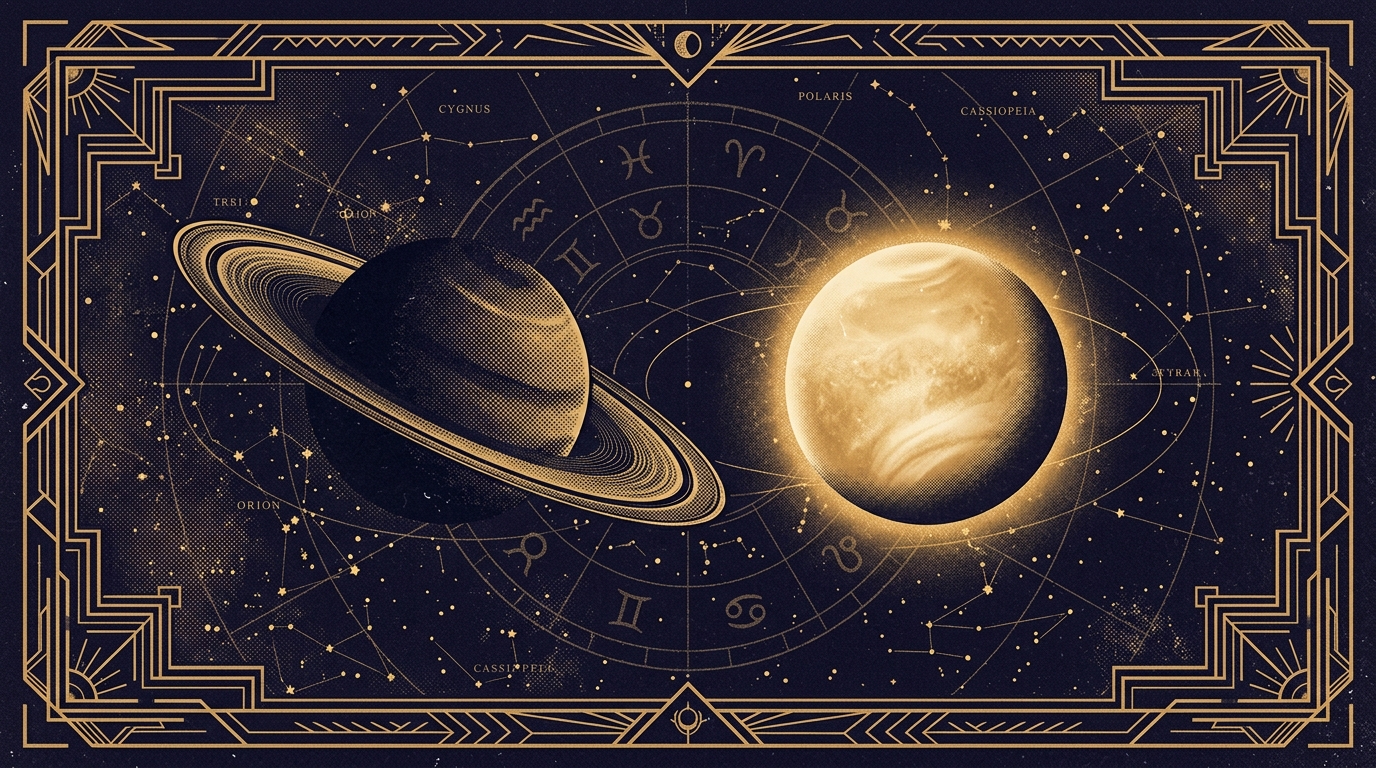
Two people meet. Within weeks, there's already talk of the future — timelines, shared goals, a seriousness that neither of them fully expected. The Venus person jokes that it 'feels like being in a relationship that's already five years old.' The Saturn person doesn't joke about it at all. That feeling? That's Saturn conjunct Venus in synastry doing exactly what it does.
This is one of the most discussed aspects in relationship astrology, and for good reason. It shows up in long-term partnerships, marriages, and — interestingly — in age-gap relationships with striking regularity. But it's also one of the most misunderstood. Most articles frame it as either a beautiful karmic bond or a recipe for emotional repression. The truth, as the data tends to show, is more nuanced and more useful than either extreme.
For a broader foundation on how Saturn operates across all relationship contacts, the Saturn aspects in synastry overview is worth reading first — it contextualizes why Saturn's involvement, far from being unwelcome, is often the factor that makes a relationship actually last.
What Saturn Conjunct Venus Means in Synastry
In synastry — the technique of overlaying two birth charts to assess compatibility — a conjunction means two planets occupy the same or very close degree. When one person's Saturn lands on another person's Venus (within approximately 6-8 degrees), the energies merge. Saturn brings structure, discipline, responsibility, and a strong orientation toward the long game. Venus brings desire, aesthetic sensibility, affection, and the need for pleasure and connection.
When these two combine in a conjunction, you don't get a gentle blend. You get a collision that eventually, if handled well, becomes a foundation.
The aspect operates differently depending on which person carries which planet.
The Saturn Person's Role: Structure and Boundaries Around Love
The Saturn person in this pairing tends to perceive the Venus person as someone worth protecting, investing in, and — here's where it gets complicated — defining. Saturn's instinct is to take something valuable and secure it. When that 'something valuable' is a person, the impulse can express as deep devotion or, at its shadow extreme, as possessiveness framed as care.
In practice, Saturn people in this dynamic often become the 'responsible one' in the relationship. They remember anniversaries with almost military precision. They think about practical compatibility — finances, life goals, logistics — early and seriously. Studies on relationship stability suggest that partners who demonstrate consistent, reliable behavior in the early stages of a relationship create significantly stronger attachment bonds, and Saturn people instinctively do this.
The Venus Person's Experience: Feeling Anchored or Restricted
The Venus person's experience of this conjunction is less straightforward. On one hand, the Saturn person's seriousness feels like a gift — here is someone who actually shows up, who doesn't play games, who treats the relationship as a real thing worth protecting. That's genuinely rare, and Venus people often recognize it immediately.
On the other hand, Venus rules freedom of expression in love. It wants lightness, playfulness, beauty for its own sake. When Saturn sits directly on that Venus, some of that lightness gets compressed. Venus people in these dynamics sometimes report feeling like they have to 'earn' affection, or that spontaneity is quietly discouraged. (This isn't always intentional on Saturn's part — it's often just Saturn being Saturn.)
How This Aspect Manifests in Real Relationships
Early Stages: Instant Seriousness and Magnetic Gravity
The early phase of a Saturn conjunct Venus relationship is almost universally described the same way: it feels significant from the start. Not necessarily romantic in a swept-off-your-feet sense, but weighty. Both people tend to sense, even without articulating it, that this isn't casual.
And statistically, they're right to sense that. Research published in relationship psychology journals consistently shows that couples who describe their early connection as 'serious' or 'purposeful' have lower breakup rates in the first two years compared to those who describe it as 'fun' or 'exciting.' Saturn conjunct Venus self-selects for that serious, purposeful quality from day one.
There's also a magnetic quality here that's worth naming. Venus is drawn to Saturn's groundedness; Saturn is drawn to Venus's warmth. Each person offers what the other, on some level, lacks. That mutual pull creates real staying power.
Long-Term Dynamics: Loyalty vs. Emotional Coldness
Long-term, this aspect's gifts and challenges both intensify. The loyalty is remarkable — Saturn conjunct Venus couples tend to stay. But 'staying' isn't automatically healthy, and this is where the aspect requires conscious attention.
Over time, if Saturn's structuring impulse isn't balanced with genuine emotional warmth, the Venus person can begin to feel more like a possession than a partner. The relationship may become functionally stable but emotionally arid. Venus starts going quiet; Saturn interprets that quiet as contentment. Both are wrong.
So the long-term success of this pairing depends heavily on whether the Saturn person learns to soften their grip — not abandon their commitment, but express it with warmth rather than rules.
Saturn Conjunct Venus and the Age Gap Question
Here's something that most Saturn-Venus articles skip over entirely: this aspect appears with notable frequency in relationships with a meaningful age difference. And that's not coincidental.
Saturn governs time, maturity, and the wisdom that comes from lived experience. Venus governs youth, beauty, and the desire for connection. When one person's Saturn lands on another's Venus in synastry, there's often a real-world age differential that mirrors that symbolic dynamic — the older, more experienced partner (Saturn) and the younger, more romantically expressive one (Venus).
This doesn't mean age-gap relationships are only explained by Saturn-Venus contacts. But it does mean that when couples with significant age differences describe their connection as feeling 'fated' or 'like we were supposed to find each other,' this conjunction is frequently present in their synastry. The older partner often plays a mentor or stabilizing role; the younger partner often brings energy and emotional openness that softens the older one.
The key consideration for age-gap couples with this aspect is power. Saturn already carries inherent authority; add a real-world age difference and the structuring impulse can tip into actual power imbalance. Both partners need to be clear about the difference between guidance and control, between protecting and limiting.
For a complete synastry chart interpretation, this age-gap dynamic is one of the contextual factors worth examining alongside the raw aspect data.
Sign-by-Sign Variations of Saturn Conjunct Venus
The conjunction's expression changes significantly depending on which zodiac sign it occurs in. Sign placement isn't a minor detail — it's the context that either amplifies or moderates the core dynamic.
In Earth Signs: Natural Harmony Between Structure and Sensuality
When Saturn conjunct Venus falls in Taurus, Virgo, or Capricorn, both planets are operating in territory that suits them reasonably well. Earth signs value stability, practicality, and loyalty — which aligns naturally with Saturn's agenda. Venus in earth signs is already oriented toward sensory pleasure and material security, rather than purely romantic idealism.
This combination in earth signs tends to produce relationships that are genuinely grounding. Finances get handled. Homes get built. Long-term plans get made and executed. The emotional temperature may not be volcanic, but there's a deep, reliable warmth that compounds over time. Couples with this placement often describe their relationship as their 'safe place.'
In Fire Signs: Tension Between Passion and Restraint
Aries, Leo, and Sagittarius are where this conjunction gets complicated. Fire signs want expansion, excitement, and freedom of expression — none of which sit comfortably under Saturn's influence. Venus in fire wants to be spontaneous; Saturn wants a plan. Venus in fire wants grand romantic gestures; Saturn wants consistent, reliable behavior over decades.
The tension here is real. But tension isn't automatically destructive. Some of the most dynamic and creatively fertile long-term relationships carry exactly this kind of productive friction. The challenge for fire sign Saturn conjunct Venus couples is learning to honor both the desire for intensity and the need for structure — not sacrificing one for the other.
In Water and Air Signs: Emotional Depth vs. Intellectual Distance
In Cancer, Scorpio, and Pisces, the conjunction takes on a deeply emotional quality. Water sign Venus already craves profound connection and emotional security — and Saturn's presence here can either deepen that sense of safety or, if expressed negatively, create emotional unavailability that wounds the Venus person's need for intimacy.
In Gemini, Libra, and Aquarius, the dynamic shifts toward the intellectual and social. These air sign placements can produce relationships built on strong mental rapport and shared values, but where the emotional layer remains somewhat cool. The Saturn person may express commitment through ideas and loyalty rather than emotional vulnerability, which air sign Venus can appreciate — though over time, it may want more warmth than Saturn naturally offers in this element.
Shadow Side: When Saturn Conjunct Venus Becomes Controlling
Let's be direct about this: Saturn conjunct Venus has a shadow, and it matters.
At its worst, this aspect produces relationships where Saturn's 'protection' curdles into control. The Venus person finds their social life monitored, their appearance critiqued, their spontaneity consistently redirected. It rarely starts dramatically — it usually begins with small corrections dressed up as care. 'I just want what's best for you.' 'You don't need those friends.' 'I know better.'
The data on controlling relationship dynamics is sobering. Relationship researchers have found that controlling behavior is consistently one of the strongest predictors of long-term relationship dissatisfaction, regardless of how much genuine affection exists between partners. Good intentions don't cancel harmful patterns.
But here's the thing — and this is important — most Saturn people in this dynamic aren't consciously trying to control. They're afraid. Saturn's deep fear is loss, instability, the unraveling of what's been carefully built. When that fear runs the relationship rather than the love underneath it, control is what comes out. Recognizing that fear — and working with it directly, often with professional support — is what transforms the aspect from a liability into its intended gift.
For context on how wounding patterns can embed themselves in relationship dynamics, the Chiron in Synastry piece explores how early wounds show up between partners — which often intersects with Saturn's behavioral patterns.
How to Work With This Aspect Consciously
Data from couples therapy research suggests that awareness of relational patterns — simply being able to name what's happening between two people — reduces the negative expression of those patterns by a meaningful margin. With Saturn conjunct Venus, conscious engagement looks like this:
1. Name Saturn's function, not just its fear. The Saturn person should regularly ask: 'Am I structuring the relationship, or the other person?' Structure the shared life — finances, plans, commitments. Don't structure who your partner is allowed to be.
2. Venus must speak, not just accommodate. Venus people in this dynamic have a tendency to go quiet rather than create conflict with Saturn's seriousness. This is a slow-building mistake. Stating clearly what feels restrictive, early and calmly, prevents years of accumulated resentment.
3. Build rituals of lightness. Saturn conjunct Venus relationships often lack play. Intentionally scheduling time for unstructured fun — travel without an agenda, spontaneous dates, creative activities with no goal — counteracts the aspect's tendency toward rigidity.
4. Review the power dynamic regularly. Especially in age-gap configurations, both partners should periodically check in: does the Venus person feel free to disagree, to change, to grow in directions Saturn didn't plan for? If the honest answer is no, that's important information.
5. Recognize the gift underneath. This aspect, consciously held, produces some of the most enduring relationships in any synastry practitioner's experience. The commitment is real. The staying power is real. The task is making sure it stays warm.
For a fuller picture of how to approach a synastry reading beyond single aspects, how to read a synastry chart provides a useful framework for weighting different factors appropriately.
Saturn Conjunct Venus vs. Other Saturn-Venus Aspects
Understanding this conjunction is sharper when you can compare it to its relatives in the Saturn-Venus family.
The Saturn trine vs. square in synastry comparison is particularly useful here. The trine between Saturn and Venus delivers many of the conjunction's gifts — commitment, stability, a sense of seriousness — but without the same intensity of friction. It's easier to carry, but it may also lack the conjunction's forging quality. Couples with the trine sometimes report feeling secure but not particularly transformed by the relationship.
The square, by contrast, is where Saturn-Venus energy becomes overtly challenging. The Saturn square Saturn in synastry dynamic offers a useful parallel — when Saturn energy conflicts rather than aligns, the result is often two people whose fundamental approach to commitment fundamentally clashes.
The conjunction sits between these poles. It has the intensity of a square without the perpetual conflict, and the depth of a trine without the ease. That middle position is what makes it so significant — and so worth understanding carefully.
And the Saturn conjunct Ascendant in synastry aspect is worth reading alongside this one, because when Saturn touches both Venus and the Ascendant in someone's chart, the effect on the Venus person's sense of self — not just their love life — becomes a central theme.
Saturn conjunct Venus in synastry isn't a guarantee of happiness. No aspect is. But it is one of the clearest signals in a chart that two people are in each other's lives for reasons that run deeper than convenience or chemistry.
The practical next step: if you suspect this aspect is active in your relationship, look at when it's showing up behaviorally. Where does seriousness feel like security? Where does it feel like a closed door? Those two answers — held honestly by both partners — are the working material of a relationship that can genuinely go the distance.