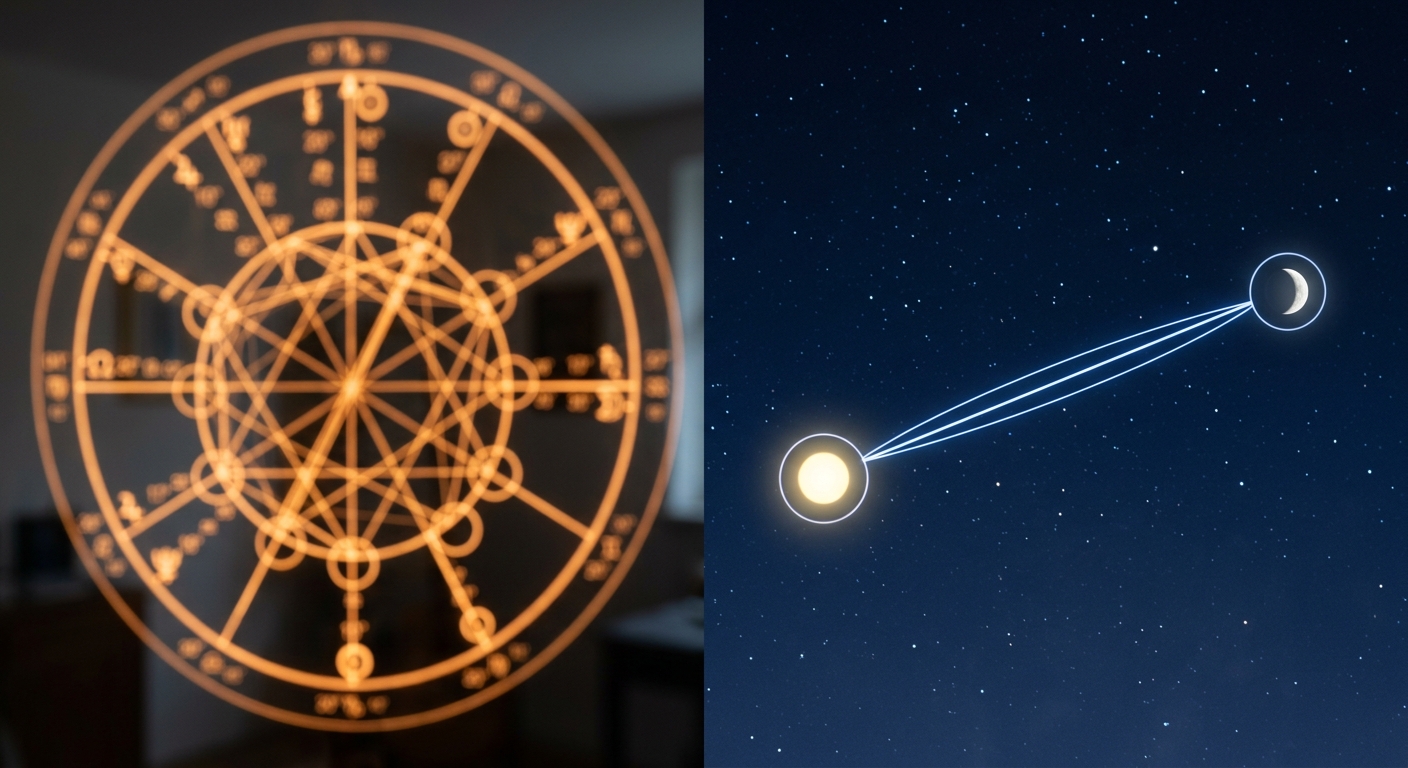
Most synastry calculators will hand you 40+ aspects and call it a reading. That's not analysis — that's noise. The real skill in synastry chart interpretation isn't finding aspects. It's knowing which ones to ignore.
Orbs are the deciding factor. A 0.3° Venus-Mars conjunction hits completely differently than a 9° one. But most beginners treat them identically. This article gives you a working framework to filter signal from noise — using orb size, planet hierarchy, and the often-overlooked applying vs. separating distinction.
Common Misconceptions About Synastry Orbs
Myth 1: All listed aspects are equally valid. They're not. A synastry calculator shows everything within its default orb threshold, often 8°–10° for all aspects. That means a 9° trine between your Mercury and their Neptune gets the same visual weight as a 1° Venus-Moon conjunction. One of these will define your relationship. The other is background wallpaper.
Myth 2: Wider orbs just mean 'weaker' — still worth reading. Sometimes, yes. But with outer planets specifically, a wide orb often means the aspect isn't personal at all. When someone born in 1990 has their Neptune at 13° Capricorn, nearly everyone born within a two-year window shares that placement. A wide Neptune aspect in synastry may say more about generational overlap than actual relational chemistry.
Myth 3: More aspects = stronger connection. In my experience, the most intense relationships often show 5–8 tight aspects, not 35 loose ones. Quantity is a distraction. Tight orbs on high-priority planets tell the real story.
Core Principles of Orb Strength in Synastry
Understanding what the angles between two charts tell you starts with one foundational concept: orbs measure exactness, and exactness determines intensity.
Here are the five principles that should govern how you read orbs:
1. Orb is a measure of proximity, not probability. An aspect either exists or it doesn't — the question is how precisely the two planets align. A 1° orb means the planets are essentially in exact mathematical relationship. A 9° orb means you're stretching to call it a connection at all.
2. Planet weight determines orb tolerance. The Sun and Moon (luminaries) are the most influential bodies in any chart. They get the most generous orb allowances — typically up to 8° for conjunctions in traditional practice. Personal planets (Mercury, Venus, Mars, Jupiter, Saturn) warrant up to 6°. Outer planets (Uranus, Neptune, Pluto) deserve tight orbs only — 2°–3° maximum — because their aspects are otherwise more generational than personal.
3. The tighter the orb, the more unavoidable the dynamic. A 0.5° Saturn square to someone's Sun will be felt in the relationship whether either person understands astrology or not. It shows up in behavior, patterns, and friction points. Wide aspects are more like tendencies — present sometimes, absent others.
4. Aspect type modifies orb tolerance. Conjunctions and oppositions are the most powerful and can sustain slightly wider orbs. Trines and sextiles, being 'soft' aspects, carry less punch even at tight orbs. Squares demand exactness to really land. So: give conjunctions and oppositions your widest allowances, squares and trines medium tolerance, and minor aspects (semisextile, quincunx) very tight orbs only — 2° maximum.
5. Context across the whole chart matters. One tight aspect in isolation might mean little. The same aspect reinforced by other chart factors — house overlays, composite patterns, nodal contacts — becomes definitive. Orbs don't operate in a vacuum.
Recommended Orb Sizes for Synastry Aspects
Luminaries vs. Personal Planets vs. Outer Planets
Here's a practical orb table based on planet type and aspect type. These are working recommendations, not dogma.
| Planet Category | Conjunction/Opposition | Square/Trine | Sextile | Minor Aspects |
|---|---|---|---|---|
| Sun, Moon (Luminaries) | Up to 8° | Up to 6° | Up to 4° | 2° max |
| Mercury, Venus, Mars | Up to 6° | Up to 5° | Up to 3° | 2° max |
| Jupiter, Saturn | Up to 5° | Up to 4° | Up to 3° | 1°–2° max |
| Uranus, Neptune, Pluto | Up to 3° | Up to 2° | Up to 2° | 1° max |
| Chiron, Nodes | Up to 4° | Up to 3° | Up to 2° | 1° max |
So when your synastry software flags a Neptune trine at 7°, you can safely deprioritize it. When it shows a Moon conjunction at 1.5°, that goes to the top of your reading list.
Tight Orbs (0°–2°): The Aspects You'll Feel Immediately
This is the high-priority tier. Full stop.
A tight orb — anything under 2° — represents an aspect so exact that the planetary energies are essentially fused. In synastry, this means the two people trigger each other's planetary themes almost automatically.
- A 1° Venus-Mars conjunction? Immediate, palpable chemistry. Often described as magnetic.
- A 0.8° Moon square Saturn? Emotional tension that appears early and doesn't fully resolve.
- A 1.5° Sun conjunct Sun? Unusual but powerful — a sense of 'meeting yourself' in the other person.
These are the aspects to analyze first in any chart comparison. Studies of long-term couples consistently show a higher-than-average incidence of tight luminaries and Venus-Mars contacts — research in the tradition of Michel Gauquelin's statistical astrology work suggested that planetary positions in close angular relationships correlate with significant interpersonal dynamics.
Don't move to the next section of a chart until you've catalogued every sub-2° aspect involving the Sun, Moon, Venus, and Mars.
Medium Orbs (3°–5°): Background Influence You Learn to Recognize
Medium orbs are real, but they're not urgent.
A 4° Venus trine Jupiter is genuinely pleasant — it adds ease and generosity to a relationship. But it won't save a chart full of tight squares and oppositions, and it won't define the relationship's character the way a 1° Moon-Pluto conjunction will.
Here's how I use medium orbs in practice:
- They help explain 'why this relationship works despite the friction' — supportive aspects in the 3°–5° range provide relief valves.
- They become more significant when they reinforce tight aspects. A 4° Venus sextile Jupiter matters more when you already have a 1° Venus-Mars trine in the same chart.
- In the absence of tight aspects, medium orbs carry more interpretive weight. (Not every relationship is defined by explosive contacts.)
For synastry house overlays and other positional factors, medium-orb aspects on house rulers can shift their importance significantly. Context, again, is everything.
Wide Orbs (6°–10°): When to Count Them and When to Ignore Them
Be honest: most wide orbs in synastry readings are filler.
The exceptions:
- Wide luminaries contacts between charts: A 7° Sun-Moon opposition can still carry weight, especially in the context of natal chart themes.
- Wide aspects that are exact in the composite or Davison chart: Sometimes what looks loose in the synastry grid is exact in the combined chart. Worth cross-checking. (This is one reason why the Davison chart vs. composite chart distinction matters practically.)
- Wide aspects involving angular houses: If a 7° Mars-Venus square involves planets near the Ascendant or Midheaven, it gets a bump in significance.
But a 9° Mercury sextile Neptune between two charts? Ignore it. That's not an aspect — that's a coincidence of degree proximity.
A good working rule: if removing the wide aspect changes nothing about your interpretation of the relationship, it wasn't contributing anything.
Applying vs. Separating Aspects in Synastry
This distinction is underused and genuinely useful.
In natal astrology, applying aspects (where the faster planet is moving toward exact) carry more weight than separating aspects (where it's moving away). The logic: applying aspects represent energy building toward expression. Separating aspects represent energy that has already peaked.
In synastry, the same principle holds — with a twist. Because we're comparing two static birth charts, neither planet is literally 'moving.' But applying vs. separating status at birth tells you something about each person's natal relationship to that planetary energy.
Here's the practical read:
- If Person A has a natal applying Venus-Mars aspect, they carry that unresolved tension into relationships. When Person B's planets activate it, it hits harder.
- A separating aspect in a natal chart suggests the person has already integrated that planetary dynamic to some degree. It still shows up in synastry, but with less raw charge.
Look at both partners' natal charts before reading synastry. Understanding what each person already carries helps you interpret why certain synastry aspects land with more intensity than their orb would suggest.
This is one reason Moon sign compatibility matters so much — the Moon's natal applying or separating aspects reveal how emotionally reactive someone is to lunar triggers from a partner.
How to Prioritize Aspects When Your Chart Is Overloaded
You've run the synastry comparison. You have 40 aspects. Now what?
Here's a five-step triage process:
Step 1: Cut everything above 5° for outer planets. Uranus, Neptune, Pluto aspects wider than 3°–4° go in the 'ignore' pile immediately. No exceptions.
Step 2: Flag all sub-2° aspects first. Highlight every aspect under 2°. These are your headline findings regardless of planet type.
Step 3: Build your planet hierarchy. Prioritize in this order: Sun, Moon, Venus, Mars, Saturn, Mercury, Jupiter. Aspects involving these planets in the 0°–5° range are your core story.
Step 4: Look for aspect clusters. When multiple aspects point to the same theme — say, three separate contacts involving Venus and Saturn — that theme is definitive. Isolated aspects, even tight ones, carry less interpretive weight than clusters.
Step 5: Check applying vs. separating in natal context. For any high-priority synastry aspect, check whether it echoes a natal applying aspect in either chart. If it does, the synastry contact is activating something pre-existing. That's significant.
For a full reading methodology — what to look at first, second, and last — the how to read a synastry chart guide walks through this sequence in detail.
Future Trends in Synastry Analysis
Two developments are worth watching.
Computational refinement of orb standards. As more synastry data gets aggregated (apps like Co-Star and Astro.com now have millions of user relationships tagged), researchers will be able to test empirically which orb thresholds actually correlate with reported relationship quality. The anecdotal 8° standard for luminaries may get revised downward — my bet is 5°–6° will prove more predictive.
Integration of progressed synastry. Progressed charts add a time dimension — aspects that form as both charts progress can reactivate dormant natal contacts. As this becomes more mainstream in practice, orb standards for progressed aspects (tighter, always) will need clearer community guidelines.
AI-assisted chart weighting. Several astrology platforms are experimenting with algorithms that weight aspects by orb tightness, planet importance, and chart context automatically. This could eventually replace the manual triage process above — though the interpretive layer will still require human judgment for the foreseeable future.
Where to Go From Here
Start with your own chart comparison. Run it through any calculator, then immediately apply the five-step triage above. You'll likely cut your aspect list from 40+ down to 8–12 high-priority contacts.
Those 8–12 aspects are your actual synastry reading.
For the interpretive layer — what those aspects mean once you've identified them — the full synastry chart interpretation framework covers each major contact type with specific behavioral patterns and relationship dynamics.
Orbs aren't the most glamorous part of synastry. But they're the filter that makes everything else readable.